Most founders pick a payment provider the way they pick a font — whatever the tutorial used, or whatever a friend's startup happened to integrate. It's an understandable shortcut, and it's also one of the more expensive ones available to a SaaS business. Payment rail choice isn't a checkout-button decision; it's a decision about how much of every rupee or dollar you actually keep, whether your Indian customers see the UPI option they expect, and whether your product is even legally allowed to skip the app store's payment system in the first place.
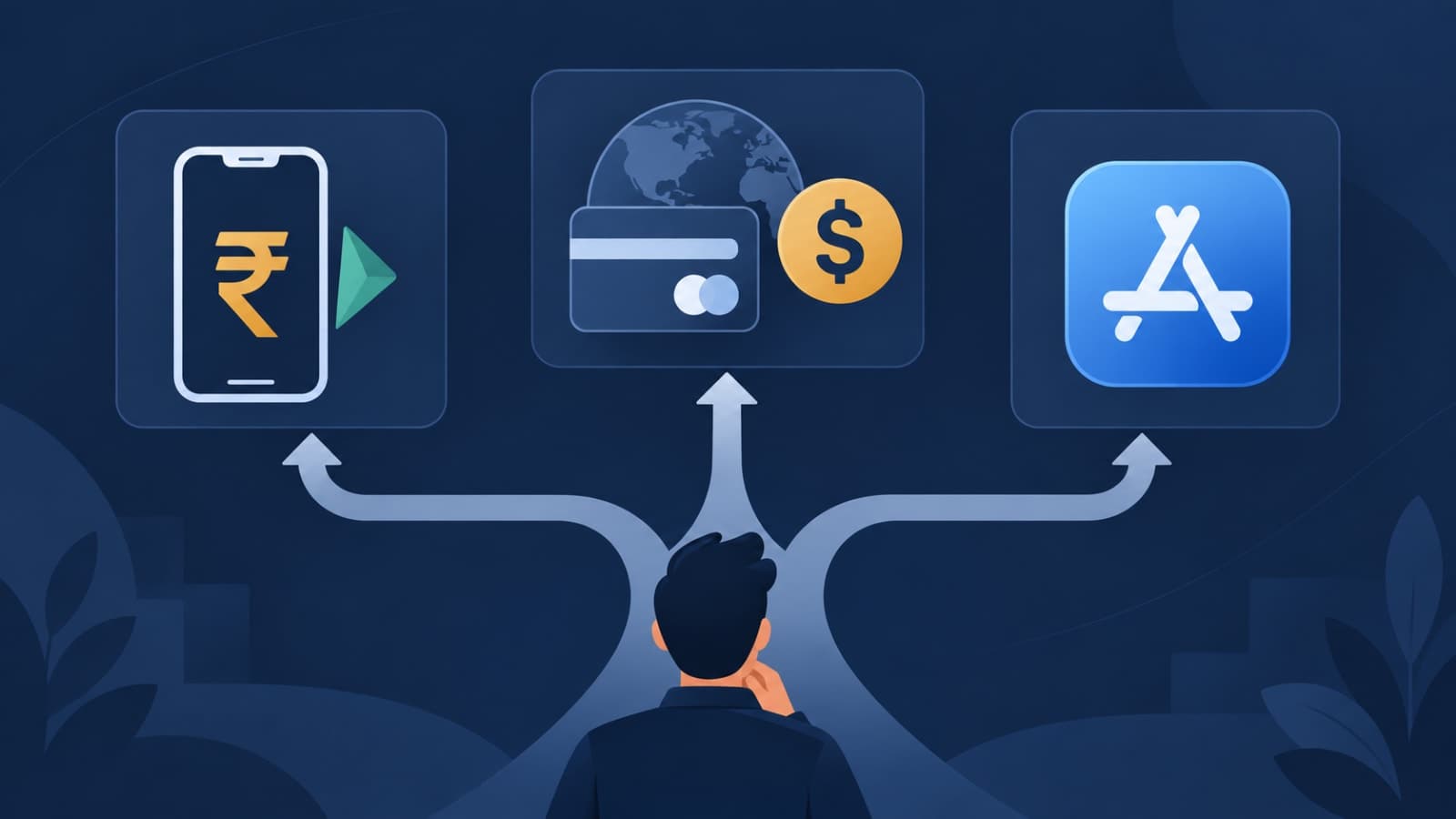
This isn't really one question. It's three, layered on top of each other: are you distributing through an app store at all, is your customer base primarily Indian or primarily international, and how much complexity are you willing to take on in exchange for lower fees. Here's how to think through each layer.
Why This Isn't One Decision — It's Three
The most common mistake is treating "which payment gateway should we use" as a single choice with one right answer. In practice, three separate questions determine your options: whether you're selling digital goods inside a native mobile app (which triggers app store rules regardless of what you'd prefer), whether your customers are mostly paying in INR or mostly in USD/EUR, and whether you're willing to run two payment systems in parallel to get the best of both. Skipping straight to "Stripe or Razorpay" without answering the first question is how founders end up rejected from app store review for using the wrong payment flow entirely.
When You're Forced Into Apple or Google IAP (And What It Actually Costs)
If your app sells digital content or features that are consumed inside a native iOS or Android app — subscriptions, premium features, virtual currency, unlockable content — app store policy has historically required you to process that specific transaction through Apple's or Google's own in-app purchase system, not a third-party gateway. This is why apps like Uber or Amazon don't use IAP for rides or physical goods — that exemption only applies to digital goods and services consumed within the app itself.
The standard commission on that transaction is 30%, dropping to 15% for developers earning under $1 million a year in in-app purchase revenue through Apple's and Google's small-business-equivalent programs. For a subscription SaaS product, that's a meaningful chunk of margin disappearing before you even get to your own costs — a point worth reading alongside how much margin should software eat into your product's price, since a 15–30% platform cut sits on top of everything else already competing for your margin.
This landscape has also been shifting fast through 2025 and 2026, largely as fallout from antitrust litigation. US App Store apps can currently include external payment links without Apple charging a commission on those transactions, following a court order — though Apple is actively appealing, and the case is now in front of the Supreme Court on a narrow legal question, so this could change again. Google's equivalent external-link program, meanwhile, has moved the other direction: as of mid-2026, developers using external payment links on Android now pay a service fee starting around 10% on their first $1 million in earnings, with mandatory reporting and payment beginning October 2026. In the EU, regulation already requires both platforms to allow external payment links regardless of court rulings elsewhere. The practical takeaway: treat your payment architecture as something you'll likely revisit within the next year, not a one-time decision, and confirm current App Store and Play Store guidelines before finalizing anything.
The text will keep moving. Treat your external-link implementation as something you will update at least once in the next twelve months, not a one-time build.
Common guidance among developers tracking app store payment policy
When Razorpay Wins: India-First UX and Economics
For a business collecting payments primarily from Indian customers, Razorpay's advantage isn't just familiarity — it's structural. Razorpay holds a Reserve Bank of India Payment Aggregator-Cross Border license, giving it native support for UPI, RuPay cards, net banking, and wallets, along with automated generation of the export documentation (e-FIRCs) needed for international collections — paperwork that otherwise has to be manually coordinated with a bank for every remittance. UPI transactions under ₹2,000 currently carry no merchant discount rate at all, following an NPCI fee waiver, which meaningfully changes the margin math for any low-ticket Indian subscription product where most payments fall under that threshold.
Razorpay's local bank routing also tends to produce higher domestic payment success rates than global gateways, since it can automatically reroute a transaction around a slow or unresponsive bank server. And for recurring billing specifically, RBI's stricter rules around automatic card debits have pushed Indian SaaS billing toward UPI AutoPay and NACH mandates rather than the credit-card-on-file model common elsewhere — something Razorpay supports natively and something worth planning for from day one if your subscription base is mostly Indian.
When Stripe Wins: Global Flexibility and Billing Maturity
Stripe's advantage shows up clearly the moment your customer base is international. Multi-currency checkout, stronger acceptance rates on non-Indian cards, and mature fraud tooling like 3D Secure all matter more once you're billing customers in the US, UK, or EU than when you're billing customers in India. Stripe's subscription billing tooling — proration on plan changes, metered usage billing, trial-to-paid conversion logic, and dunning for failed payments — is also considerably more mature than most India-first alternatives, which matters if your pricing model involves anything more complex than a flat monthly fee.
It's worth knowing that Stripe's presence in India has narrowed rather than grown in recent years: since mid-2024, Stripe India has operated on an invite-only basis for new accounts and doesn't support domestic INR transactions the way Razorpay does. In practice, this makes Stripe the right default for a product billing internationally, and a poor fit as your only gateway if a meaningful share of revenue comes from Indian customers paying in rupees. If you're taking IAP-driven subscriptions on iOS or Android, our guides on building a production-ready in-app purchase subscription flow and how to test app store subscriptions cover the implementation details either provider eventually has to work alongside.
The Common Answer for Indian SaaS Founders: Run Both
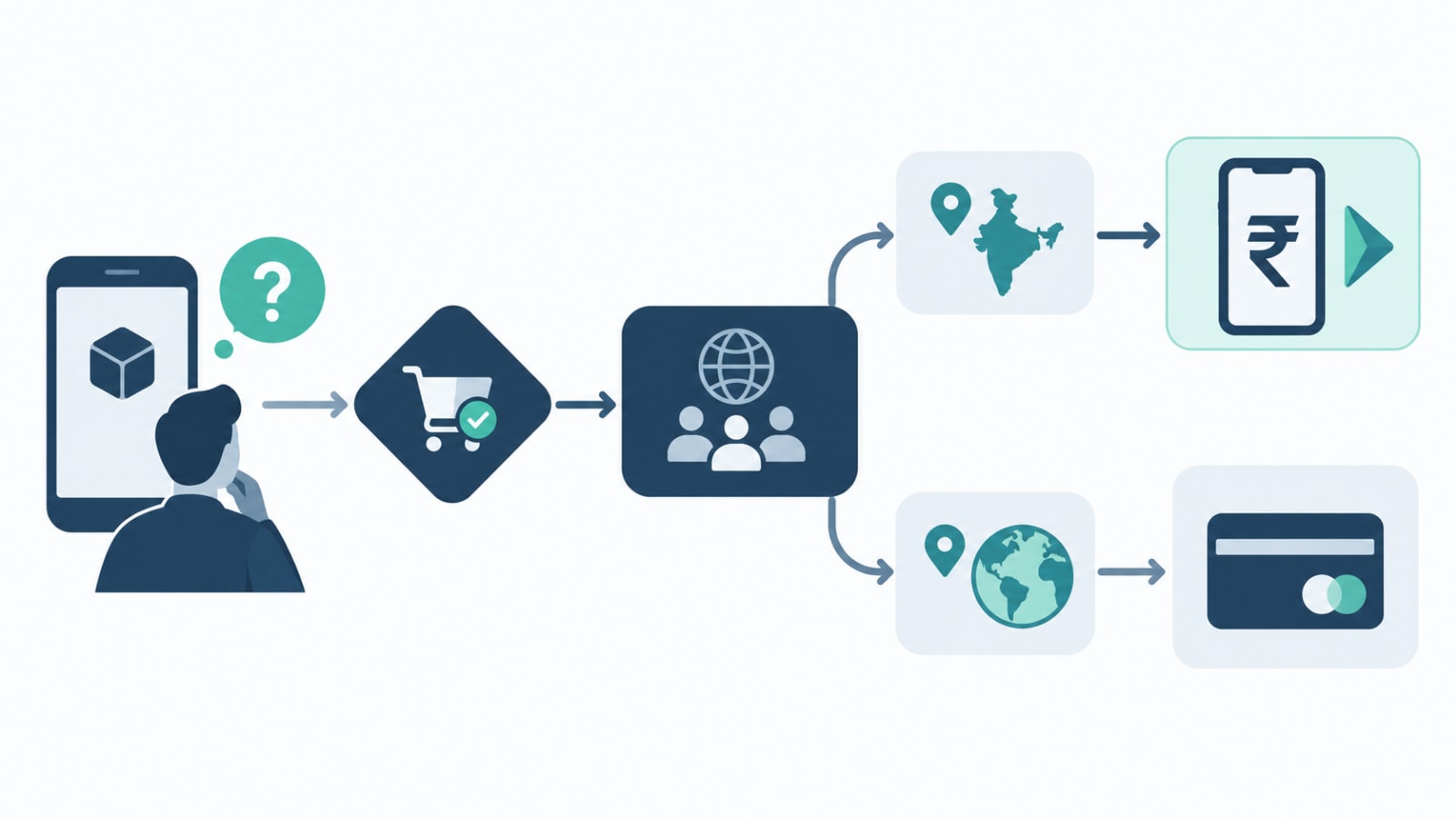
For an India-founded SaaS business with genuinely international ambitions, the pattern that shows up repeatedly among practitioners isn't "choose one" — it's Razorpay for domestic Indian customers and Stripe for international ones, running in parallel. Each rail handles the payment method and compliance requirements it's actually built for, rather than forcing one gateway to be excellent at everything.
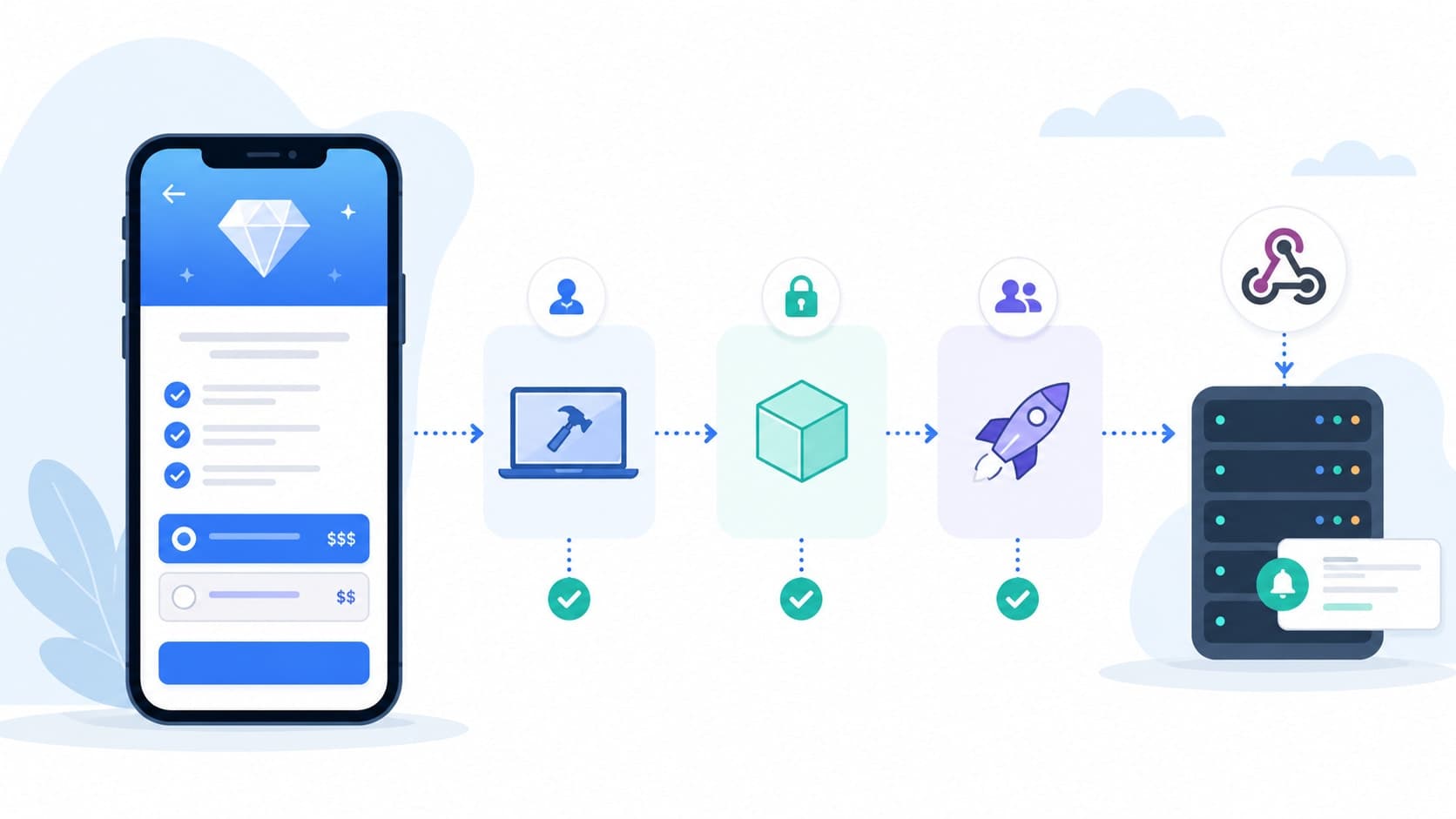
The cost of that approach isn't in fees — it's in reconciliation. Two payment providers means two separate webhook streams telling your app when a subscription renewed, failed, or canceled, and your system needs a single source of truth for "is this customer's subscription active" regardless of which rail processed the payment. Get that reconciliation wrong, and you end up with the exact kind of cross-system disagreement covered in the 6 systems every SaaS founder doesn't see until something breaks — a customer's status showing differently depending on which dashboard your team happens to be looking at.
A Practical Decision Framework
- Is the purchase for digital content consumed inside a native app? If yes, app store rules likely require IAP for that specific transaction, regardless of your gateway preference elsewhere — verify current guidelines, since exemptions and external-link rules are actively changing by region.
- Are your customers mostly Indian, paying in INR? Start with Razorpay for UPI support, lower fees on small transactions, and RBI-compliant recurring billing.
- Are your customers mostly international, paying in USD or EUR? Start with Stripe for multi-currency support and more mature subscription billing tooling.
- Do you genuinely have both? Plan for running both rails from the start rather than bolting a second one on later — and design your subscription state as a single source of truth that both webhook streams update, not two competing ones.
- Is this a web-only product with no app store distribution? The IAP question doesn't apply — choose based purely on customer geography and billing complexity.
What Nobody Puts in the Estimate
- Reconciliation engineering: keeping subscription state consistent across two payment providers' webhooks is real, ongoing engineering work, not a one-time integration task.
- Tax and compliance overhead: GST invoicing for Razorpay transactions and VAT/sales tax handling for Stripe's international customers are different compliance requirements running side by side.
- Currency and settlement timing: international collections through Razorpay still require export documentation, even with e-FIRC automation reducing the manual burden.
- The cost of building two integrations instead of one: this is exactly the kind of dependency that turns a "simple" payments feature into a multi-system change, echoing the point made in how much developer time does "just one more feature" actually cost.
How We Approach This at Fall Rise
Payment rail selection is one of the first architecture conversations we have on any product handling money, because it shapes decisions well beyond checkout — subscription state management, webhook handling, and reconciliation logic all follow from this choice. On Bhaada, our logistics and cargo platform, wallet payouts to driver-partners run through a domestic, UPI-first setup built for Indian settlement speed and reliability. On FieldOps, our field service management platform, the customer portal handling quotes and payments needed straightforward, low-friction domestic payment collection that trades businesses and their customers already trust. You can see more of how we scope payment infrastructure across our project portfolio.
This kind of payment architecture decision comes up on nearly every SaaS platform and mobile app we build, and it's part of why we treat backend API design as a foundational decision rather than an afterthought — the payment rail you choose on day one determines how much engineering work reconciliation and compliance require for years afterward. If you're still deciding how to price around whichever rail you land on, how to decide pricing for your SaaS product is a natural next read.
There's no universally correct payment rail — there's only the right one for where your customers are, what you're selling, and how much complexity you're prepared to manage in exchange for lower fees. Get this decision right early, and it stays invisible. Get it wrong, and it becomes the kind of margin leak or compliance headache that's expensive to unwind later. If you're scoping payments for a new product and want a second opinion on the right setup, let's talk.