

Most founders price their SaaS product the same way: look at two or three competitors, pick a number that feels roughly in the middle, and move on. It's understandable — pricing feels like the one decision you can make in an afternoon instead of a sprint. But price is the single lever that touches every other metric in the business simultaneously: it sets your ARPU, determines how fast you recover customer acquisition cost, and shapes who churns and who expands. Getting it approximately right from data beats getting it exactly wrong from instinct.
Start With Price-to-Value Ratio, Not Cost-Plus
The most common pricing mistake is anchoring to cost — "it costs us $X to run this feature, so we'll charge $X plus margin." Customers don't care what something costs you to build; they care what it's worth to them. The price-to-value ratio is the relationship between what you charge and the outcome the customer gets — hours saved, revenue generated, risk avoided. A tool that saves a team $10,000 a month can comfortably charge $500, even if it costs you $20 a month to run, because the ratio of value delivered to price paid still feels like an easy decision for the buyer. Price against the value you create, and use cost only as a floor, never as the anchor.
The Core Metrics That Should Actually Drive Your Number
ARPU — Average Revenue Per User
ARPU (or ARPA — average revenue per account, more common in B2B) is your total recurring revenue divided by your number of paying customers over a given period. It's the number every other pricing decision gets measured against: raise your price and ARPU rises immediately, but only if conversion and retention hold steady. Track ARPU by segment, not just as a blended average — a single blended number hides whether your enterprise tier or your self-serve tier is actually carrying the business.
Customer Acquisition Cost and Break-Even (Payback) Period
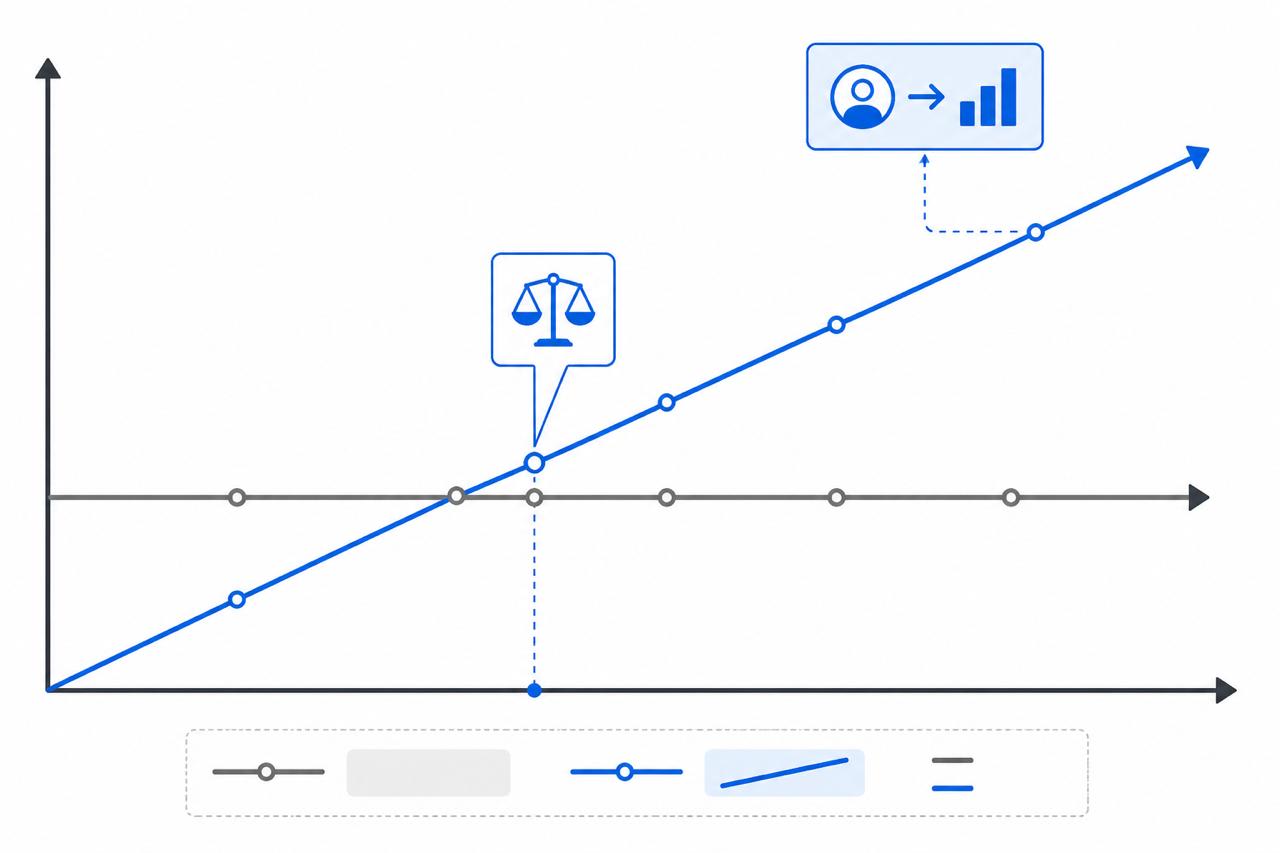
CAC is your total sales and marketing spend divided by the number of new customers it produced. On its own it's just a cost figure; paired with ARPU it becomes the CAC payback period — how many months of revenue from a customer it takes to earn back what you spent acquiring them. The formula is CAC ÷ (ARPU × gross margin). Across B2B SaaS in 2026, the median payback period sits around 15–16 months, with top-quartile companies recovering CAC in 6–8 months and anything beyond 24 months generally considered a red flag by investors. If your price is too low relative to your acquisition cost, no amount of growth fixes the underlying math — you're recycling less capital back into growth with every customer you sign.
Retention — Gross and Net
Price interacts directly with retention in both directions. Price too high relative to perceived value and gross churn rises; price too low and you leave expansion revenue on the table as customers outgrow a plan that was never designed to scale with them. Net revenue retention (NRR) — existing revenue after churn, downgrades, and expansion — is one of the clearest signals that pricing and packaging are working together correctly. Median NRR across B2B SaaS segments in 2026 runs from roughly 97% for SMB-focused products up to 108–118% for mid-market and enterprise products, and the gap between those numbers is largely a function of whether pricing has room to expand as customers grow, not just whether the product is sticky.
- ARPU = Total recurring revenue ÷ number of paying customers, tracked by segment.
- CAC = Total sales & marketing spend ÷ new customers acquired in the period.
- CAC payback period = CAC ÷ (ARPU × gross margin) — expressed in months.
- LTV:CAC ratio = Customer lifetime value ÷ CAC — a 3:1 ratio or better is the commonly cited healthy target, though only a minority of SaaS companies consistently hit it.
- NRR = (Starting revenue − churn − contraction + expansion) ÷ starting revenue, measured over 12 months.
Common SaaS Pricing Models
- Flat-rate — one price, one feature set. Simple to sell and support, but leaves money on the table with high-usage customers and caps expansion revenue.
- Tiered — several fixed packages (Starter / Growth / Enterprise) differentiated by features or limits. The default for most B2B SaaS because it gives customers a natural upgrade path.
- Per-seat — price scales with number of users. Predictable and easy to forecast, but can actively discourage adoption inside a customer's organisation.
- Usage-based — price scales with consumption (API calls, storage, transactions processed). Aligns revenue directly with the value delivered, and tends to produce stronger NRR because expansion happens automatically as usage grows.
- Freemium — a free tier drives adoption, with paid tiers unlocking depth or scale. Effective for self-serve, product-led motions, but only works if the free tier is genuinely useful without cannibalising the paid one.
- Hybrid — a fixed platform fee plus a usage component. Increasingly common because it gives you the predictability of a base subscription with the upside of usage-based expansion.
A Practical Framework for Setting Your Price
- Map your value metric — identify the single unit that best correlates with the value a customer gets (seats, projects, API calls, revenue processed) and consider anchoring pricing to it rather than to feature count alone.
- Research willingness to pay — run a Van Westendorp price sensitivity survey or structured customer interviews to find the range between "too cheap to trust" and "too expensive to consider."
- Build 3–4 tiers around real usage patterns, not arbitrary feature gates — each tier should map to a distinct customer segment with a distinct value story, not just "more of everything."
- Set an initial price against your break-even target — work backward from the CAC payback period you need to hit, given your expected acquisition cost and gross margin, rather than picking a number and hoping the unit economics work out.
- Launch, then measure conversion, ARPU, and early churn by tier — the first price you set is a hypothesis, not a commitment; plan to revisit it within the first two quarters.
- Track NRR and expansion revenue continuously — pricing that only optimises for new-customer conversion, without a path for existing customers to pay more as they grow, caps your ceiling long before the product does.
Other Factors That Shift the Number
- Competitive anchoring — buyers compare your price to alternatives whether or not you want them to; know where you sit and be deliberate about it, rather than accidentally pricing yourself as the budget option.
- Market segment — self-serve SMB products typically carry lower ARPU and lower CAC; enterprise sales-led products carry the inverse. Pricing strategy should match the go-to-market motion, not fight it.
- Geography and purchasing power — a single global price list can price you out of some markets and leave money on the table in others; regional pricing is worth testing once you have meaningful volume outside your home market.
- Packaging psychology — the number of tiers, the position of the "recommended" plan, and even charm pricing (₹999 vs ₹1,000) measurably shift which tier customers choose, independent of the underlying value.
- Discounting discipline — heavy discounting to close deals extends your CAC payback period and often attracts customers who churn faster; a rarely-discounted list price is easier to defend than a system built around negotiation.
Price is not a number you calculate once at launch — it's a lever you keep recalibrating against ARPU, CAC payback, and retention as the product and market mature.
Common practice among SaaS product and growth teams
How We Think About Pricing at Fall Rise Infotech
When we help founders scope a new SaaS product at Fall Rise Infotech, pricing strategy is part of the product conversation from day one, not a decision left for launch week. On products like Bhaada, our logistics platform, that's meant designing the data model itself to support usage-based and hybrid pricing later, even if the initial launch uses a simpler flat-rate structure — retrofitting a value metric into a system that wasn't built to track it is far more expensive than planning for it up front. You can see more of this kind of product work across our project portfolio.
There's no universal "right" SaaS price — there's only the price that matches your value metric, your acquisition cost, and the retention behaviour you're seeing from real customers. Treat your first price as a hypothesis, instrument it properly, and revisit it on a quarterly cadence rather than setting it once and hoping. If you're scoping a new SaaS product and want help thinking through pricing and packaging before you build, let's talk.