Short answer (updated October 2026): in India in 2026, a basic mobile app MVP typically costs ₹3–6 lakh (about $3,600–7,200) when an agency builds it end to end, a mid-complexity app with accounts, payments, and real-time features ₹6–11 lakh (about $7,200–13,200), and a complex marketplace-style app ₹14 lakh ($17,000) and up. The rest of this guide explains where those numbers come from, what changes them, and the running costs that come after launch. If you'd rather skip to a quote for your own app, see how our
mobile app development team scopes a first version.
Mobile app cost by complexity
The biggest driver of cost is scope: how many screens and user roles the app has, and how much the backend has to do. These are the ranges we see for a fully inclusive agency build — design, mobile development, backend, QA, and store submission — using one cross-platform codebase for Android and iOS.
Typical mobile app cost in India, 2026 (agency, fully inclusive)| App type | Typical scope | Cost (INR) | Approx. USD | Typical timeline |
|---|
| Basic MVP | One core flow, login, no payments | ₹3–6 lakh | $3,600–7,200 | 6–8 weeks |
| Mid-complexity app | Accounts, profiles, payments, real-time data, admin panel | ₹6–11 lakh | $7,200–13,200 | 8–12 weeks |
| Complex / marketplace app | Multiple user types, admin panel, payouts, live tracking | ₹14 lakh+ | $17,000+ | 12 weeks+ |
USD figures are approximate conversions. Broader market data for India puts a basic MVP anywhere from ₹2–8 lakh and a mid-complexity app at ₹8–20 lakh — the spread comes from what each quote actually includes, which is why a line-by-line scope matters more than the headline number.
Mobile app cost by who builds it
The same app costs very different amounts depending on how it's staffed. Hourly rates look cheapest with freelancers, but the total often isn't.
| Hiring model | Rate or price | What's usually included | Main risk |
|---|
| Freelancers (separate mobile and backend) | Mobile ₹1,500–4,000/hr; backend ₹1,200–3,500/hr | Development only — design, QA, and deployment are extra | You coordinate integration; costs grow with rework |
| Agency (fixed price) | ₹3–6 lakh basic, ₹6–11 lakh mid-complexity | Scoping, design, mobile, backend, QA, store submission, warranty | Higher quoted number up front |
| In-house team | Salaries plus hiring and management overhead | Whatever the team can cover | Slow to hire; ongoing cost even between projects |
For a mid-complexity app, two freelancers typically quote around ₹8–11 lakh for core development alone. Once design, QA, deployment, and coordination are added back, the realistic total is closer to ₹13–17 lakh. We break that comparison down hour by hour in our
Flutter app cost breakdown, and compare team models in
in-house vs outsourced development.
What drives the cost up
- Number of user types — an app for customers only is far cheaper than one with customers, drivers or staff, and an admin panel, because each role needs its own screens and permissions.
- Backend complexity — real-time updates, location matching, scheduling, and anything that moves money take the most engineering time.
- Integrations — payment gateways, maps, SMS or WhatsApp OTP, calendar sync, and e-signing each add setup, testing, and edge cases.
- Platforms — building separate native iOS and Android apps roughly doubles mobile work compared with one cross-platform codebase.
- Design depth — a custom design system and animations cost more than a clean, standard UI.
- Compliance and security — handling health, financial, or personal data adds access control, audit trails, and review time.
A cross-platform framework like Flutter or React Native builds one codebase that runs on both Android and iOS, so most apps need roughly half the mobile development of two separate native apps. Native development still makes sense for apps that lean heavily on platform-specific hardware or the newest OS features. For most business apps, cross-platform is the cheaper and faster route — see
Flutter vs React Native development cost for a framework-level comparison. If you're launching on one platform first, our
Android app development and
iOS app development pages cover what each store launch involves.
Costs after launch that quotes often leave out
| Cost | Typical amount | Notes |
|---|
| Apple Developer Program | $99 per year | Required to publish on the App Store |
| Google Play developer account | $25 one-time | Required to publish on Google Play |
| Hosting and database | Varies with usage | Often small at launch, grows with users and data |
| Third-party services | Per use | SMS/OTP, maps, email, and payment gateway fees |
| Maintenance and updates | Often budgeted at 15–20% of build cost per year (rule of thumb) | OS updates, bug fixes, security patches, small features |
Store fees are set by Apple and Google — check the current amounts on the
Apple Developer Program page and Google's
Play Console registration help page before you budget.
How to keep the cost down without cutting corners
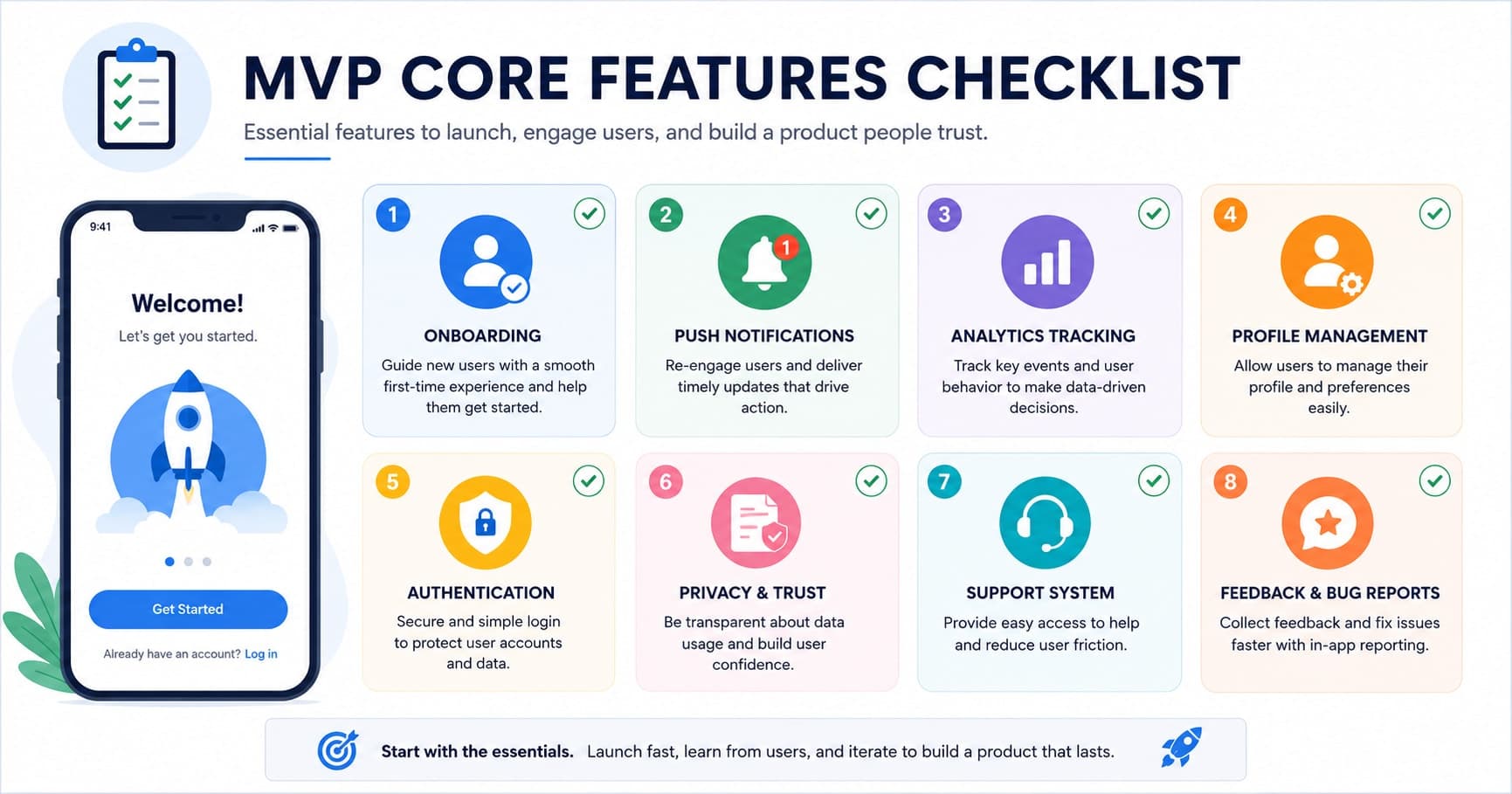
- Start with an MVP that proves one core flow, not the full product — see the 12 features every MVP actually needs.
- Write a clear product requirements document before you ask for quotes, so every quote covers the same scope. Our free PRD template helps.
- Choose one cross-platform codebase unless you have a specific reason to go native.
- Ask for a fixed, itemised quote that includes design, QA, deployment, and a post-launch warranty — not just development hours. Our 12 questions to ask before hiring an agency help you compare.
FAQ
How much does it cost to build a simple app?
A simple app with one core flow and login typically costs ₹3–6 lakh (about $3,600–7,200) in India when an agency builds it end to end, and takes around 6–8 weeks.What affects the cost of an app in India?
Mostly scope: how many user types the app has, how much the backend does, and which integrations it needs (payments, maps, OTP). After that come platforms (one cross-platform codebase or two native apps), design depth, and any compliance requirements for health or financial data.Why do app development quotes vary so much?
Because quotes include different things. One may cover only development hours; another includes design, backend, QA, store submission, and a warranty. Compare quotes line by line against the same written scope.Is it cheaper to build an app in India?
Usually, yes. Developer rates in India are lower than in the US or Europe, so the same scope typically costs less. The quality depends on the team, so judge an agency by its shipped apps and process, not by price alone.How long does it take to build a mobile app?
A focused MVP typically takes 6–12 weeks. Complex apps with several user types, payments, and real-time features take 12 weeks or more.What are the ongoing costs of an app after launch?
Expect the Apple Developer fee ($99 per year), hosting and database costs that grow with usage, per-use fees for services like SMS and payments, and maintenance — often budgeted at 15–20% of the build cost per year.What does app maintenance include?
OS and SDK updates when Apple and Google release new versions, security patches, bug fixes, monitoring and backups, and small feature changes. Our
hosting and deployment service covers the infrastructure side of keeping an app running.
Want a real number for your app instead of a range?
Get in touch — we scope your first version and give you a fixed, itemised quote. Or see how we approach
mobile app development.