
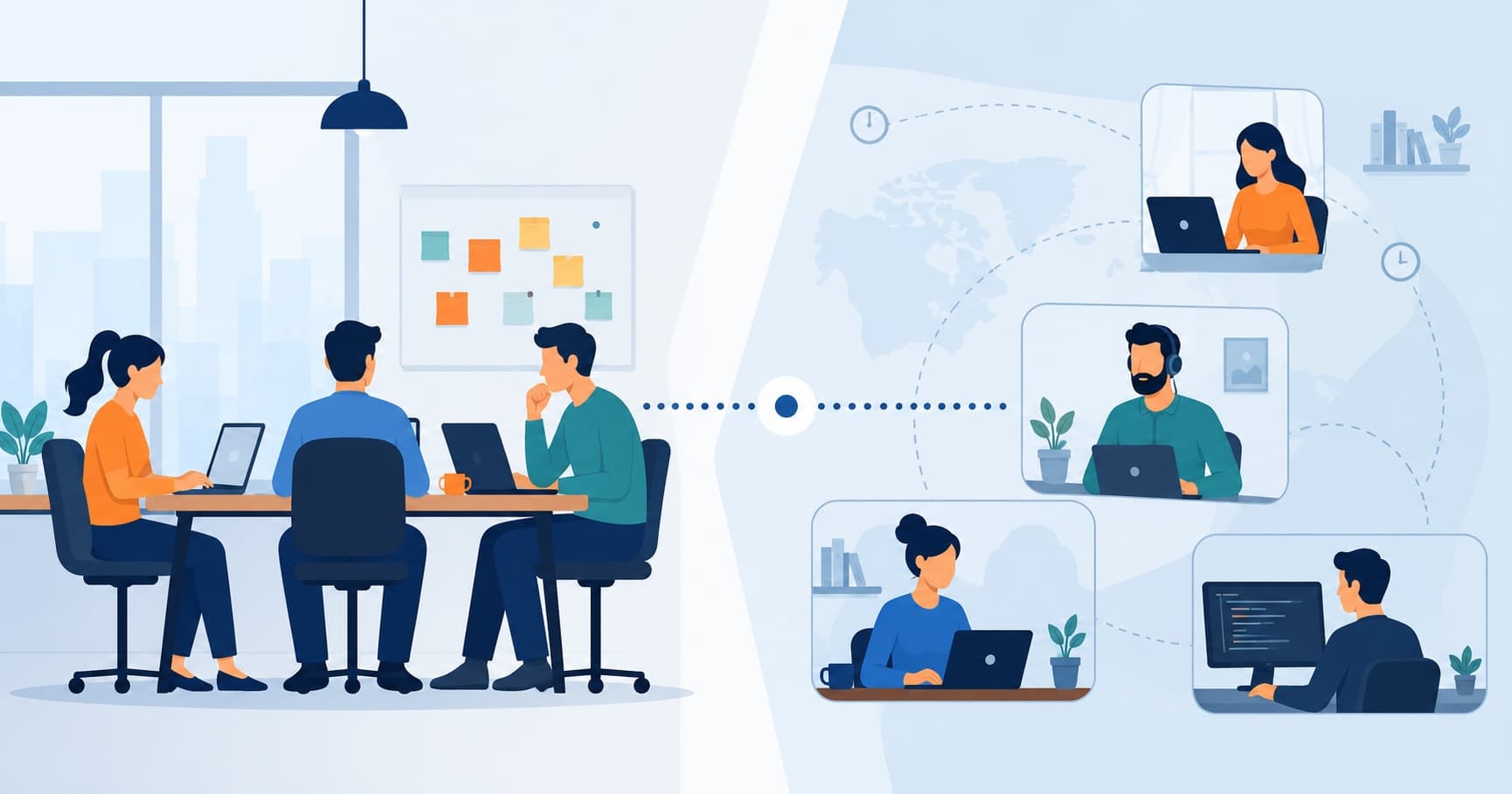
At some point, every founder has to answer the same question: do we hire developers, or do we bring in a team that already exists? It feels like a hiring decision, but it's really a strategic one — it shapes your burn rate, your speed to market, and how much control you have over your own product roadmap. There's no universally correct answer, only the one that fits where your company actually is right now. This guide breaks down both models honestly, including where each one quietly fails.
What Each Model Actually Means
An in-house team is made up of full-time employees who work exclusively on your product, report into your org chart, and are physically or culturally embedded in your company. An outsourced team is an external company or set of contractors — like a dedicated custom software development partner — who build your product under a contract, using their own hiring pipeline, processes, and management structure. Everything else in this comparison follows from that one structural difference.
The Case for an In-House Team
In-house makes the strongest case when your software is the business, not a supporting function of it. If your product is your primary revenue channel — think a fintech app or a marketplace — the people building it need deep, compounding knowledge of your codebase, your customers, and your edge cases. That kind of institutional memory is hard to buy on a contract basis.
- Full context and continuity — engineers accumulate product knowledge over years, not weeks, and that knowledge doesn't walk out the door at the end of a contract.
- Direct, daily control — priorities can shift in real time in a standup, without renegotiating a scope-of-work document.
- Tighter culture and communication — engineering sits next to product and design, so decisions happen faster and with less translation loss.
- Long-term IP and security confidence — sensitive code and data stay inside employment agreements you control directly.
The Trade-offs of Going In-House
- Slow, expensive hiring — sourcing, interviewing, and onboarding a single strong engineer routinely takes 6–10 weeks and real recruiting budget.
- Fixed cost regardless of workload — salaries, benefits, and payroll taxes continue whether the team is heads-down or waiting on the next roadmap decision.
- Narrow skill coverage — a five-person team can't reasonably cover mobile, backend, DevOps, and design at a senior level simultaneously.
- Painful to resize — scaling down after a bad quarter means layoffs, not simply not renewing a contract.
The Case for Outsourced Development
Outsourcing exists to solve the exact problems in-house struggles with: speed, flexibility, and access to specialists you don't need full-time. A team like Fall Rise typically has engineers who've already shipped mobile applications, backend APIs, and production deployments dozens of times over, so a startup isn't paying to have mistakes made and learned from on its own dime.
- Faster start — a scoped project can begin within days instead of the weeks a hiring pipeline requires.
- Access to specialists on demand — bring in a DevOps engineer or a payments specialist for exactly as long as the work requires, no permanent headcount added.
- Lower fixed cost — you pay for delivered work, not idle bench time, vacation, or benefits.
- Proven process — an experienced partner has already solved the standard early-stage problems: auth, payments, deployment pipelines, app store submissions.
The Trade-offs of Outsourcing
- Less day-to-day control — priority changes go through a communication channel and a scope conversation instead of a hallway chat.
- Knowledge lives partly outside the company — good documentation and handover practices matter more than they would with a permanent team.
- Vendor selection risk — quality varies enormously between outsourcing partners, so due diligence and a strong first small engagement matter.
- Time zone and communication overhead — can be minimal with the right partner, but it's a real coordination cost worth planning for.
The question isn't 'which model is better' — it's 'which problems can I afford to have right now.' In-house buys you control and trades away speed. Outsourcing buys you speed and trades away some control. Pick the trade-off that matches your actual constraint.
Common wisdom among early-stage CTOs
Cost Comparison: What You're Really Paying For
The sticker price of a monthly outsourced retainer often looks larger than a single developer's salary line — until the full cost of an in-house hire is accounted for. A fully-loaded in-house engineer typically costs 1.3–1.6x their base salary once recruiting, benefits, equipment, payroll overhead, and management time are included. Outsourced engagements fold most of that overhead into the rate.
- In-house: base salary + benefits + recruiting cost + onboarding time + equipment + management overhead, paid whether or not there's active roadmap work.
- Outsourced: a project or retainer rate that already includes hiring, benefits, and tooling on the vendor's side — you pay for output, not headcount.
- Hybrid: a smaller in-house core (product owner, one senior engineer) paired with an outsourced team for execution — often the lowest total cost for a pre-Series-A startup.
What Should Your Startup Actually Choose?
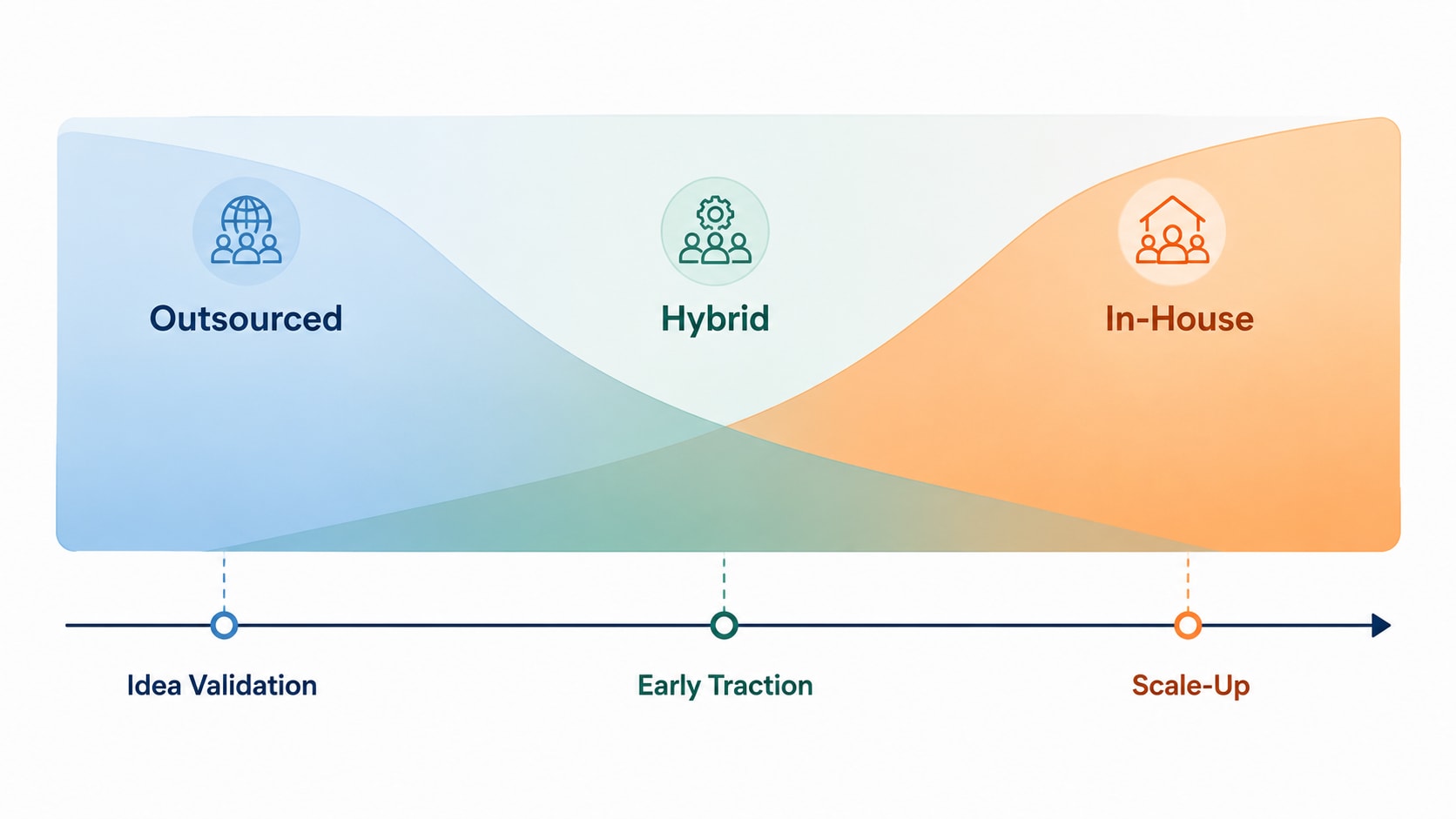
Pre-Funding or Idea Validation Stage
At this stage, speed to a testable product matters more than anything else. Hiring an in-house team before you've validated demand risks burning runway on salaries before you know if the product should exist in its current form. An outsourced partner building a lean MVP — often through SaaS development or mobile app development engagements — gets you to a testable product without a multi-month hiring detour.
Post-Seed or Early Traction Stage
Once you have real users and a product that's proven worth iterating on, a hybrid model tends to work best: a founder or early technical hire owns product direction in-house, while an outsourced team continues shipping features at a pace an early in-house team usually can't match while it's still being assembled.
Scale-Up and Series A and Beyond
As the product becomes the core of the business and headcount budget grows, the balance usually shifts toward in-house — for the institutional knowledge, tighter security controls, and long-term ownership it provides. Even here, most scaled companies keep an outsourced partner for specialized or overflow work, rather than building every capability internally.
The Hybrid Model: Increasingly the Default
Very few companies run purely in-house or purely outsourced today. The common pattern: an outsourced partner builds and ships the initial product — mobile app, backend, and deployment pipeline included — while the founding team hires its first in-house engineers to own the product long-term. The handover is smoothest when the outsourcing partner documents thoroughly and hands over infrastructure access cleanly, rather than treating the codebase as a black box.
How Fall Rise Helps Startups Decide
We've built products across both ends of this spectrum — full outsourced builds, hybrid engagements where we work alongside a founder's first hires, and long-term retainers that function as an extension of an in-house team. Whether you need a complete custom software build, a SaaS product from scratch, or just the hosting and deployment layer sorted out so an in-house team can focus on features, the right engagement model depends entirely on your stage — not a fixed rule. You can see examples of both models in our project portfolio, including products like Bhaada that started as an outsourced build and matured alongside the founding team.
There's no permanent winner between in-house and outsourced development — only the model that matches where your company is today, and a plan for how that might change. If you're trying to figure out which one fits your startup right now, let's talk — we can walk through your stage, budget, and roadmap and tell you honestly which model we'd recommend, even if it isn't us.