

Every founder comparing Flutter and React Native eventually asks the same question: which one actually costs less to build? The honest answer is that the cost gap between the two frameworks is smaller than most agencies make it sound — but the factors that drive your final number are bigger than the framework choice itself. This guide breaks down real Flutter vs React Native development costs in India for 2026, what actually moves the price up or down, and how to pick the right one for your app.
Flutter vs React Native: A Quick Refresher
Both are cross-platform frameworks that let you ship one codebase to iOS and Android instead of maintaining two separate native apps. Flutter, built by Google, uses the Dart language and renders every pixel itself through its own engine, which gives it consistent UI across platforms. React Native, built by Meta, uses JavaScript/TypeScript and, since its New Architecture became the default, compiles much closer to native components than it used to. Both are production-ready, well-funded, and used by large-scale apps today.
Why Cost Comparisons Are Often Misleading
Most “Flutter vs React Native cost” articles compare a hypothetical basic app in isolation, which ignores the variable that actually swings your budget the most: what the app needs to do. A ten-screen booking app and a ten-screen fintech app with KYC, payments, and real-time tracking are not the same project, regardless of framework. Treat the ranges below as a starting point for budgeting conversations, not a quote.
What Actually Drives App Development Cost in India
- App complexity — number of screens, user roles, and custom workflows
- Backend requirements — a simple CRUD API costs far less than real-time features, complex business logic, or heavy third-party integrations
- Design work — custom UI/UX from scratch costs more than working from an existing design system
- Third-party integrations — payments, maps, chat, analytics, and push notifications each add development and testing time
- Team seniority — a senior developer costs more per hour but often ships faster and with fewer bugs, which can lower total cost
- Platform scope — an iOS-only or Android-only build costs less than shipping both from day one
Flutter Development Cost in India (2026)
Flutter's single rendering engine and mature widget library tend to keep development timelines — and therefore cost — slightly lower for UI-heavy apps. Based on current market rates across Indian agencies and freelancers, here's roughly what Flutter projects cost in 2026:
- MVP / basic app (3–5 core screens, simple auth, no complex backend) — roughly ₹2,00,000 to ₹5,00,000
- Mid-complexity app (10–20 screens, custom backend, payments, notifications) — roughly ₹5,00,000 to ₹14,00,000
- Enterprise-grade app (real-time features, multiple user roles, heavy integrations) — ₹15,00,000 and up
Monthly rates for a mid-level Flutter developer in India typically fall between ₹30,000 and ₹80,000, with senior developers and specialised agencies commanding more depending on scope and turnaround time.
React Native Development Cost in India (2026)
React Native draws from a much larger pool of JavaScript developers in India, which keeps hiring costs slightly more competitive — though the gap has narrowed as Flutter adoption has grown. Typical 2026 ranges look like this:
- MVP / basic app — roughly ₹3,00,000 to ₹6,00,000
- Mid-complexity app — roughly ₹6,00,000 to ₹16,00,000
- Enterprise-grade app — ₹16,00,000 and up
Monthly rates for a mid-level React Native developer in India generally range from ₹25,000 to ₹70,000 — marginally lower than Flutter in many markets, mainly due to the larger talent pool rather than any real skill premium.
So Which One Is Actually Cheaper?
Across most project tiers, Flutter tends to land 10–20% lower on raw development cost, largely because a single rendering engine and consistent widget behaviour mean less time spent fixing platform-specific UI bugs. React Native claws some of that back through slightly lower hourly rates and faster onboarding for teams that already know JavaScript. For most standard business apps — e-commerce, booking, service marketplaces, logistics tracking — the difference is rarely large enough to be the deciding factor on its own.
Beyond the Sticker Price: Total Cost of Ownership
The upfront build cost is only part of the picture. Maintenance, updates, and hosting add up over an app's lifetime, and this is where the framework choice compounds. A single Flutter or React Native codebase means one set of bug fixes and one release cycle instead of two, which is the real long-term saving over native development. Where the two differ is dependency management: React Native's ecosystem leans more heavily on third-party packages, which occasionally break on OS updates and need active monitoring; Flutter's more self-contained ecosystem tends to need fewer emergency fixes.
- Hosting and backend infrastructure — ongoing server, database, and API costs apply regardless of frontend framework
- Third-party package upgrades — budget a few hours per quarter to keep dependencies current on either framework
- App store maintenance — OS updates from Apple and Google occasionally require framework or plugin updates to stay compliant
- Feature additions — post-launch features typically cost less per screen than the initial build, since the core architecture is already in place
Does Performance Still Affect Cost in 2026?
Performance debates between the two frameworks have mostly settled down. React Native's New Architecture — its JSI bridge replacement, Fabric renderer, and TurboModules — removed the old bridge bottleneck that used to be its biggest weakness, and it's now the default in new projects. Flutter still holds a slight edge for apps with heavy custom animation or highly branded UI, since it renders every pixel itself rather than relying on native components. For a typical business app, neither framework's performance will noticeably affect development cost or timeline anymore.
The cheapest app is the one that ships, gets adopted, and doesn't need a rewrite a year later.
Fall Rise product philosophy
Which One Should You Choose?
Once the cost gap is this narrow, the framework decision should follow your product and team, not the other way around:
- Choose Flutter if your app relies on custom, brand-heavy UI, complex animations, or you eventually want to expand to web and desktop from the same codebase.
- Choose React Native if your team already has strong JavaScript/TypeScript skills, you want to move fastest with existing web developers, or you're building on top of an existing React web app.
- Choose either if you're building a standard business app — e-commerce, booking, CRM, service marketplace — where the cost and performance difference won't be the deciding factor.
- Think beyond a mobile app if your project is really an internal ops platform or custom business logic with a mobile front-end — that's a custom software problem first and a framework choice second.
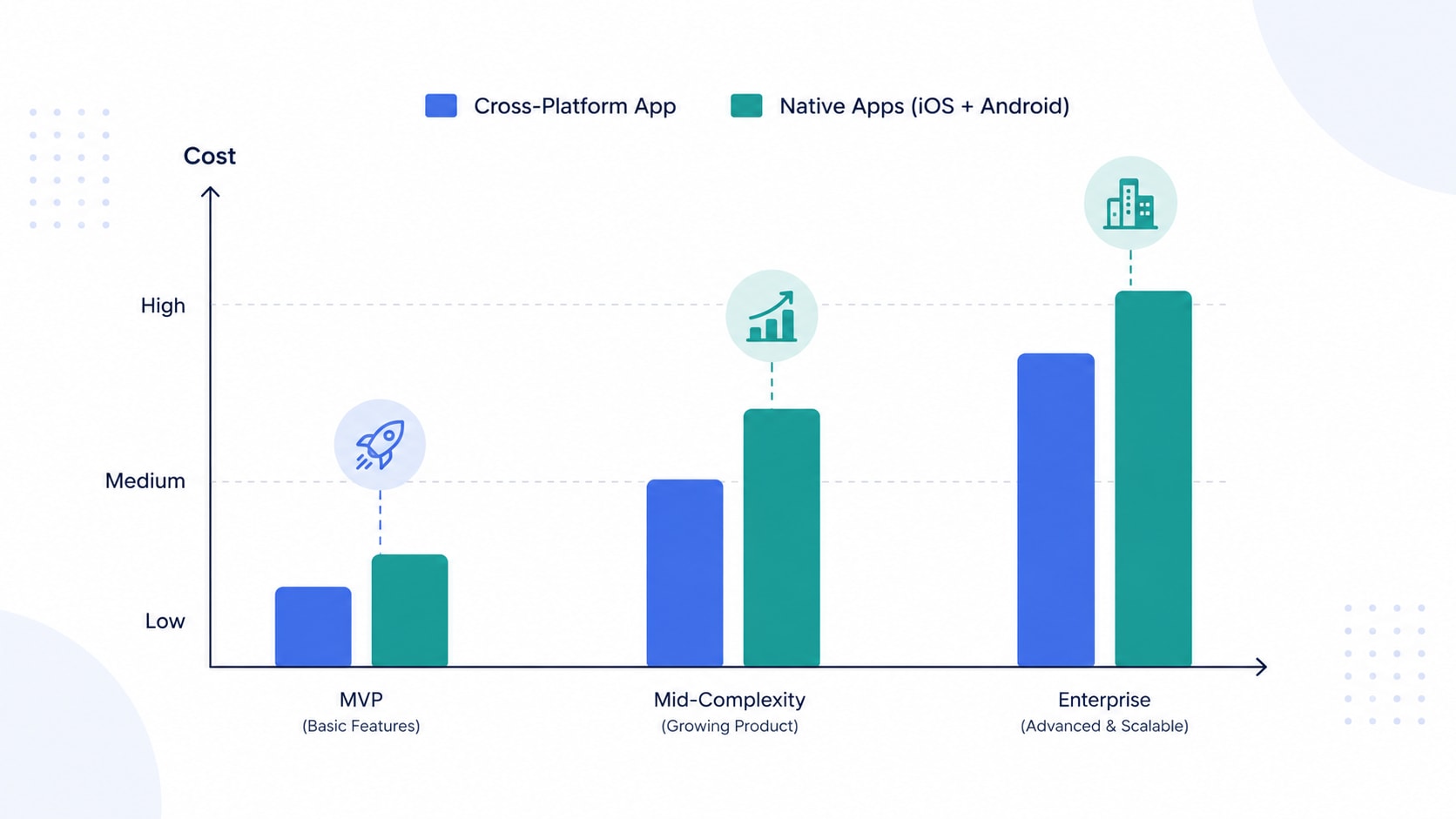
- Consider native only if you need AR/VR, real-time gaming, or day-one access to brand-new OS-level APIs — expect roughly double the cost and two codebases to maintain.
How Fall Rise Approaches This Decision
We don't default to one framework for every client — we scope the actual product first. For Bhaada, our logistics and parcel booking platform, Flutter was the right call: a consistent, trust-building UI across driver and customer apps mattered more than shaving a few percentage points off hourly rates. For clients coming from an existing React web app, we've built React Native apps that share components and business logic with the web codebase, cutting real development time. Our mobile application development team scopes both options honestly during discovery, rather than pushing whichever framework happens to be easier for us to staff.
Whichever framework you land on, the backend rarely gets the attention it deserves in these comparisons — and it usually costs more than the frontend. Our backend API development and hosting and deployment services are built to plug into either framework without locking you into a specific stack. And if your app is really a multi-tenant product rather than a single business tool, our SaaS development team can help you scope that from day one instead of retrofitting it later.
The Flutter vs React Native decision is rarely as close as the cost tables suggest once you factor in your team, your timeline, and what the app actually needs to do. If you want a straight, no-pressure estimate for your specific project — not a generic tier — let's talk. We'll scope it honestly, including which framework makes sense and why.