
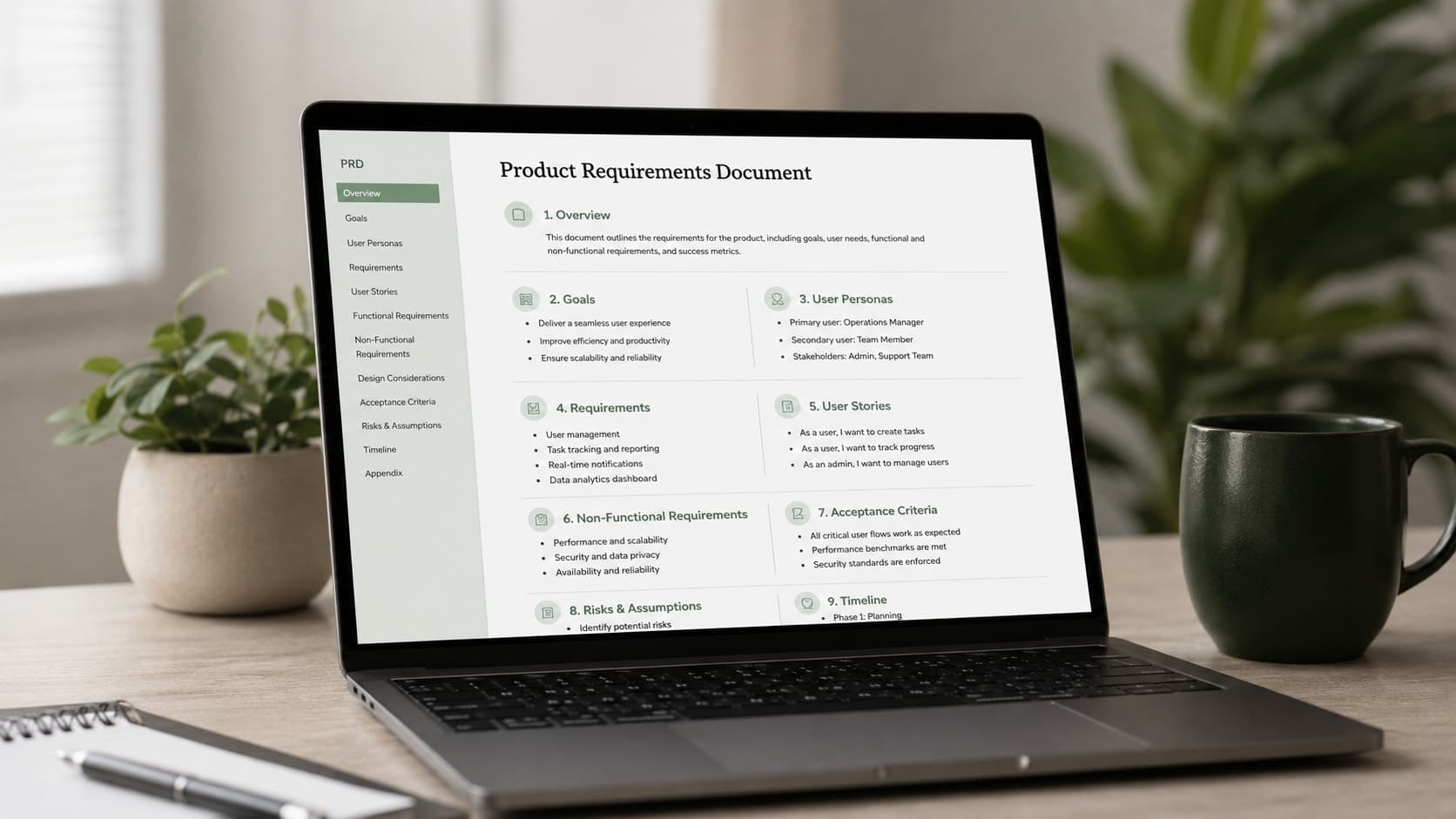
Half the pain in shipping software isn't writing the code — it's discovering three weeks into a build that the designer, the backend engineer, and the founder were each building a slightly different product in their heads. A Product Requirements Document (PRD) exists to close that gap before it opens. Done right, it's a single page (or few) that everyone building the product — and everyone paying for it — can point to and say "this is what we agreed on."
We write a PRD for nearly every product we build at Fall Rise, whether it's a consumer mobile app, an internal admin tool, or a full SaaS platform. This post covers what actually belongs in one, what founders tend to over-include, and includes a free template you can copy and start filling in today.
What a PRD Actually Does
A PRD is not a specification for engineers and it's not a pitch deck for investors — it sits in between. Its job is to answer three questions well: what problem are we solving, for whom, and how will we know we solved it? Everything else in the document exists to support answering those three questions clearly enough that a designer, a backend engineer, and a QA tester could each read it and build the same thing without needing to ask you what you meant.
The best PRDs are living documents, not a one-time artifact written before kickoff and forgotten. As discovery continues and assumptions get tested, the document should be updated — a PRD that no longer matches what's actually being built is worse than no PRD at all, because it gives false confidence to anyone who reads it.
Why You Need One (Even for a Small MVP)
It's tempting to skip a formal PRD for a small team or an early-stage MVP — "we're only three people, we all talk every day." In practice, that's exactly when a PRD earns its keep. It forces the founder to make scope decisions explicit before a developer has to guess mid-sprint, and it gives everyone a single reference point to argue against instead of relying on memory of a Slack conversation from two weeks ago. When we scope a build — whether it's a mobile application, a SaaS product, or a set of backend APIs — the PRD is what turns a founder's idea into something an engineering team can actually estimate and build against.
- Alignment — one document everyone agrees describes the same product, instead of three people building three versions of it.
- Scope discipline — a written non-goals section makes it much harder for scope to quietly creep mid-build.
- Faster onboarding — a new designer, engineer, or stakeholder can read the PRD instead of getting a verbal re-explanation.
- A record of decisions — six months later, it answers "why did we build it this way" without anyone needing to remember.
What a Good PRD Should Contain
There's no single mandated format, but the PRDs that actually get used share the same core sections. Here's what to include, roughly in the order it should appear.
1. Overview and Problem Statement
A short paragraph — three to five sentences — stating what the product or feature is, and the specific problem it solves. Write the problem statement before you write anything about the solution; if you can't state the problem cleanly, the rest of the document will drift.
2. Goals and Success Metrics
What does success look like, in numbers where possible? "Users like it" isn't a goal — "reduce signup drop-off from 40% to under 20% within 60 days of launch" is. This section is also where you state the business goal the product serves, not just the user-facing one.
3. Target Users and Personas
Who is this actually for? A short description of the primary user segment (and secondary, if relevant) keeps every downstream decision — feature priority, tone of copy, UI complexity — anchored to a real person instead of an imagined average user.
4. User Stories or Key Use Cases
Written as "As a [user], I want to [action], so that [outcome]" or as short narrative use cases. This is the bridge between the problem statement and the feature list — it's where you describe behaviour, not implementation.
5. Functional Requirements
The actual list of features and behaviours the product must have, ideally grouped by priority (must-have, should-have, nice-to-have). This is the section engineers reference most, so keep each requirement specific and testable — "users can reset their password via email" rather than "good password recovery."
6. Non-Functional Requirements
Performance, security, availability, and compliance expectations — page load targets, uptime requirements, data residency rules, accessibility standards. These are easy to skip and expensive to retrofit. If uptime and deployment strategy matter for the product, this is also where hosting and deployment requirements get scoped, so infrastructure decisions aren't made as an afterthought after launch.
7. Non-Goals (What This Product Is Not)
Just as important as what you're building is what you're explicitly not building — at least not yet. Stating non-goals in writing is what prevents scope creep three sprints in, when a "small addition" starts sounding reasonable in a meeting.
8. Design and User Flow References
Links to wireframes, mockups, or a prototype, plus a plain-language walkthrough of the primary user flow. The PRD doesn't need to contain the designs themselves — it needs to point to them and describe the flow in words for anyone who can't open the design file.
9. Technical Considerations and Dependencies
Any known technical constraints, third-party integrations, or dependencies on other teams or systems. This section doesn't need to be a full architecture doc — for products where the underlying build is complex, that level of detail belongs in a separate technical spec produced alongside custom software development planning, not buried inside the PRD.
10. Timeline and Milestones
Target dates for major milestones — not a full project plan, just enough to align expectations on when things are realistically landing.
11. Open Questions and Risks
An honest list of what's still unresolved. A PRD that pretends everything is decided is less useful than one that flags its own uncertainty — it tells the team exactly where more discovery is still needed.
12. Approval and Sign-off
Who needs to sign off before development starts, and a place to record that they did. This matters more than it sounds like it should — it's what prevents "I never actually agreed to this" conversations after launch.
A PRD that everyone agrees with but nobody re-reads during the build has already failed at its actual job.
Common wisdom among product teams
What to Leave Out of a PRD
A PRD fails just as often from having too much in it as too little. If a document is 40 pages long, nobody on the team is actually reading it before they build — they're skimming it once and working from memory after that. A few categories to deliberately keep out:
- Pixel-level UI specifications — exact spacing, colours, and component states belong in the design file, not retyped into a document that will immediately go stale the moment the design changes.
- Detailed technical architecture — database schemas, API contracts, and infrastructure diagrams deserve their own technical design document; cramming them into the PRD makes it unreadable for non-technical stakeholders.
- Marketing and launch copy — taglines, app store copy, and campaign messaging belong in a separate go-to-market document, not mixed into a document engineers reference for build scope.
- Legal or contractual language — terms of service, data processing agreements, and vendor contracts should live with legal documentation, not paraphrased into a product doc where they'll drift out of date.
- Every possible edge case — exhaustive edge-case documentation belongs in QA test plans. The PRD should cover the primary flow and the edge cases material enough to change scope, not every conceivable branch.
The pattern behind all five: each one already has a better home. A PRD's value comes from staying focused enough that people actually read the whole thing before building — padding it with content that belongs elsewhere defeats that purpose.
Free PRD Template
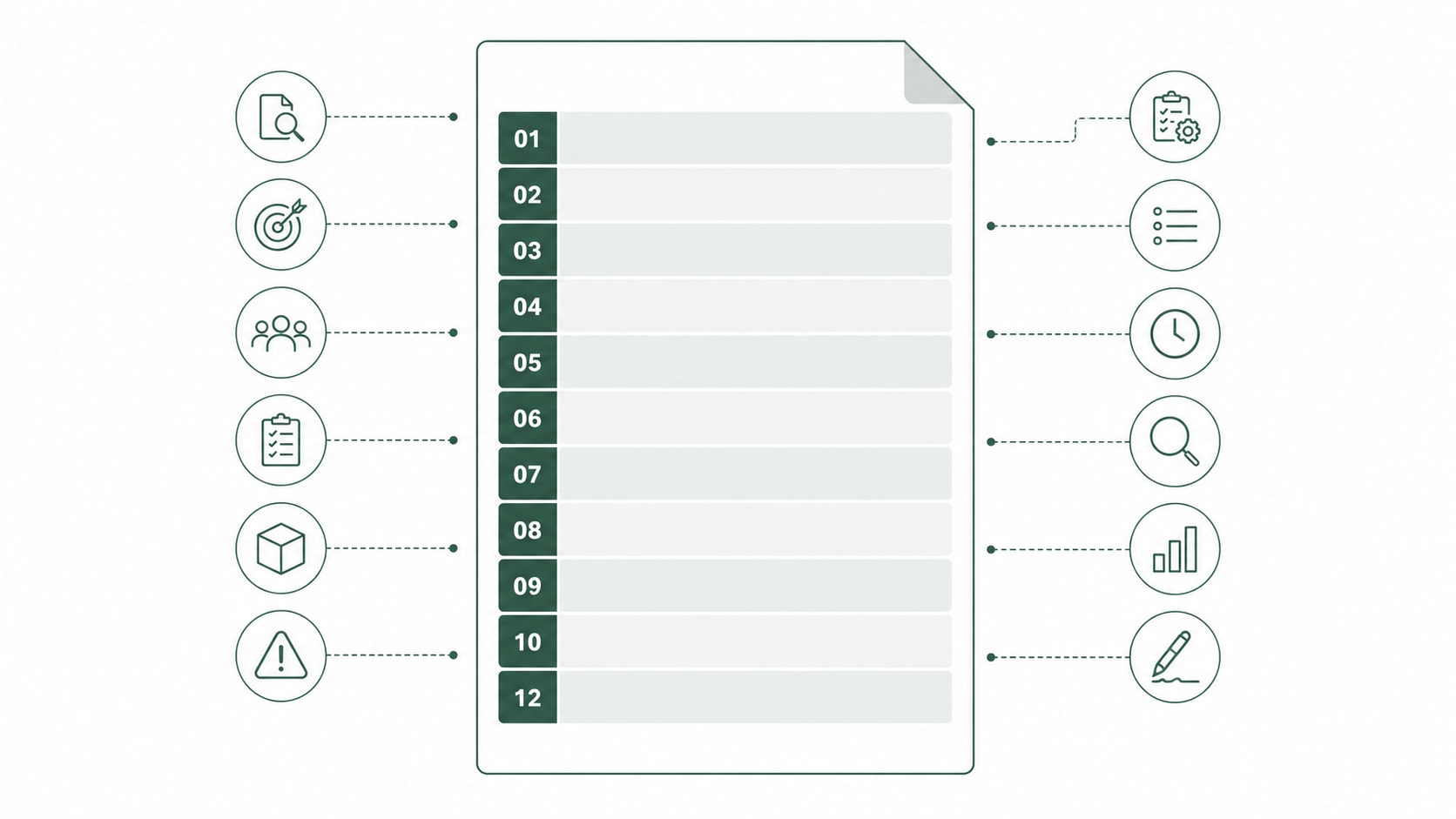
To make this easier to act on rather than just read about, here's a ready-to-use PRD template covering all twelve sections above, structured so you can duplicate it for every new feature or product. Download the free PRD template and start filling it in for your next build.
How We Use PRDs at Fall Rise
Before any build starts — mobile app, SaaS platform, or backend system — we work with founders to turn a rough idea into a PRD everyone can build against. It's the difference between a project that drifts in scope every sprint and one that ships close to what was actually planned. If you're scoping a product and want help turning your idea into a build-ready PRD, take a look at what we've built or our custom software development process.
A PRD isn't paperwork for its own sake — it's the cheapest insurance a team has against building the wrong thing well. Start with the template above, keep it honest about what's unresolved, and update it as the product evolves instead of filing it away after kickoff. If you want a second opinion on scoping your next product, let's talk.