

"How much will my app cost?" is the first question every founder asks, and the one most agencies answer with a vague range designed to get you on a call. So let's actually answer it. This post breaks down what a Flutter app costs to build in India in 2026 — not just the headline number, but where that number comes from, and how it changes depending on whether you hire a freelancer for the mobile app and a separate freelancer for the backend, or hire a single agency to own the whole build.
What You're Actually Paying For
"App cost" isn't one line item — it's the sum of several distinct pieces of work, and how those pieces are staffed is what actually drives the final number. Before comparing hiring models, it helps to separate out what a Flutter build is made of:
- Discovery & scoping — turning a rough idea into a feature list, user flows, and a realistic timeline.
- UI/UX design — wireframes and a visual design system the app is actually built against.
- Flutter (mobile) development — the app itself: screens, state management, offline behaviour, platform quirks.
- Backend development — the API, database, authentication, and business logic the app talks to.
- QA & testing — device testing, edge cases, and regression checks before anything ships.
- Deployment & app store submission — build pipelines, signing, Play Store and App Store review.
- Post-launch support — the bug fixes and small changes that show up in week one after real users arrive.
Market data on Flutter app development cost in India in 2026 puts a basic MVP anywhere from roughly ₹2–8 lakh, and a mid-complexity business app (auth, payments, real-time data, an admin panel) between ₹8–20 lakh, with enterprise builds going well beyond that. The wide range exists because two quotes covering the "same" app can include completely different combinations of the list above — which is exactly where the freelancer-vs-agency decision starts to matter.
Route 1: Hiring Two Freelancers — One for Mobile, One for Backend
This is the instinctive first move for a lot of founders: hire a Flutter freelancer for the app, hire a separate Node.js or Django freelancer for the backend, and save on agency overhead. On paper the hourly math looks attractive. In practice, it's the model where the final bill is hardest to predict.
The Hourly Math
- Flutter freelancer (India) — roughly ₹1,500–4,000/hr ($20–50), depending on experience.
- Backend freelancer (India) — roughly ₹1,200–3,500/hr ($15–45), depending on stack and experience.
- A mid-complexity app (accounts, profiles, one payment flow, real-time data) typically needs ~300 hours of mobile work and ~180–220 hours of backend work to reach a launchable MVP.
- Run the math and the core development cost alone lands around ₹8–11 lakh — before design, QA, or deployment are accounted for.
That number looks like a win against a typical agency quote. The gap closes fast once you account for everything two independent freelancers don't include by default.
What the Hourly Rate Doesn't Include
- No shared project management — you become the person translating between the mobile freelancer and the backend freelancer, on top of running your business.
- Sequential dependency, billed in parallel — the mobile freelancer often can't build real screens until the backend exposes working APIs, so you frequently pay both for weeks where only one is actually productive.
- Integration is nobody's job — when the app and the API don't agree on a data shape or an auth flow, each freelancer reasonably says "that's the other person's bug," and you pay to have it debugged twice.
- Design is a third hire — most mobile-only freelancers expect a finished UI design; if you don't have one, that's another freelancer and another few lakh before development even starts.
- QA is usually self-reported — "it works on my machine" is common when nobody outside the two freelancers is testing the integrated product.
- Deployment and app store submission are often out of scope — signing, provisioning, and store review get treated as an afterthought and billed as extra hours.
- Continuity risk — if either freelancer disappears mid-project (a real and common occurrence on freelance platforms), you're paying a new hire to re-learn a half-built codebase from scratch.
The real cost of the two-freelancer route usually isn't the hourly rate — it's the coordination tax nobody puts on the invoice.
Common pattern across founder post-mortems on freelance hiring
Route 2: Hiring a Single Agency
A fixed-price custom software development engagement folds project management, design, mobile development, backend development, QA, and deployment into one contract with one team that's accountable for the whole thing, shipping, not just their individual piece of it — and at a lean studio, that doesn't have to mean paying big-agency rates for it.
- Basic MVP (single flow, no payments) — roughly ₹3–6 lakh, fully inclusive.
- Mid-complexity app (auth, profiles, payments, real-time features) — roughly ₹6–11 lakh, fully inclusive.
- Complex / marketplace-style app (multi-sided, admin panel, payouts) — roughly ₹14 lakh and up, scaling with feature depth.
- One point of contact and one contract, so scope disagreements get resolved internally instead of between two independent parties.
- Mobile and backend developers who already work together daily, so integration issues surface during development, not after handoff.
- A defined post-launch warranty window is typically included, rather than billed as a surprise afterthought.
The trade you're making is straightforward: a higher quoted number in exchange for a much narrower range of what the final, real cost turns out to be.
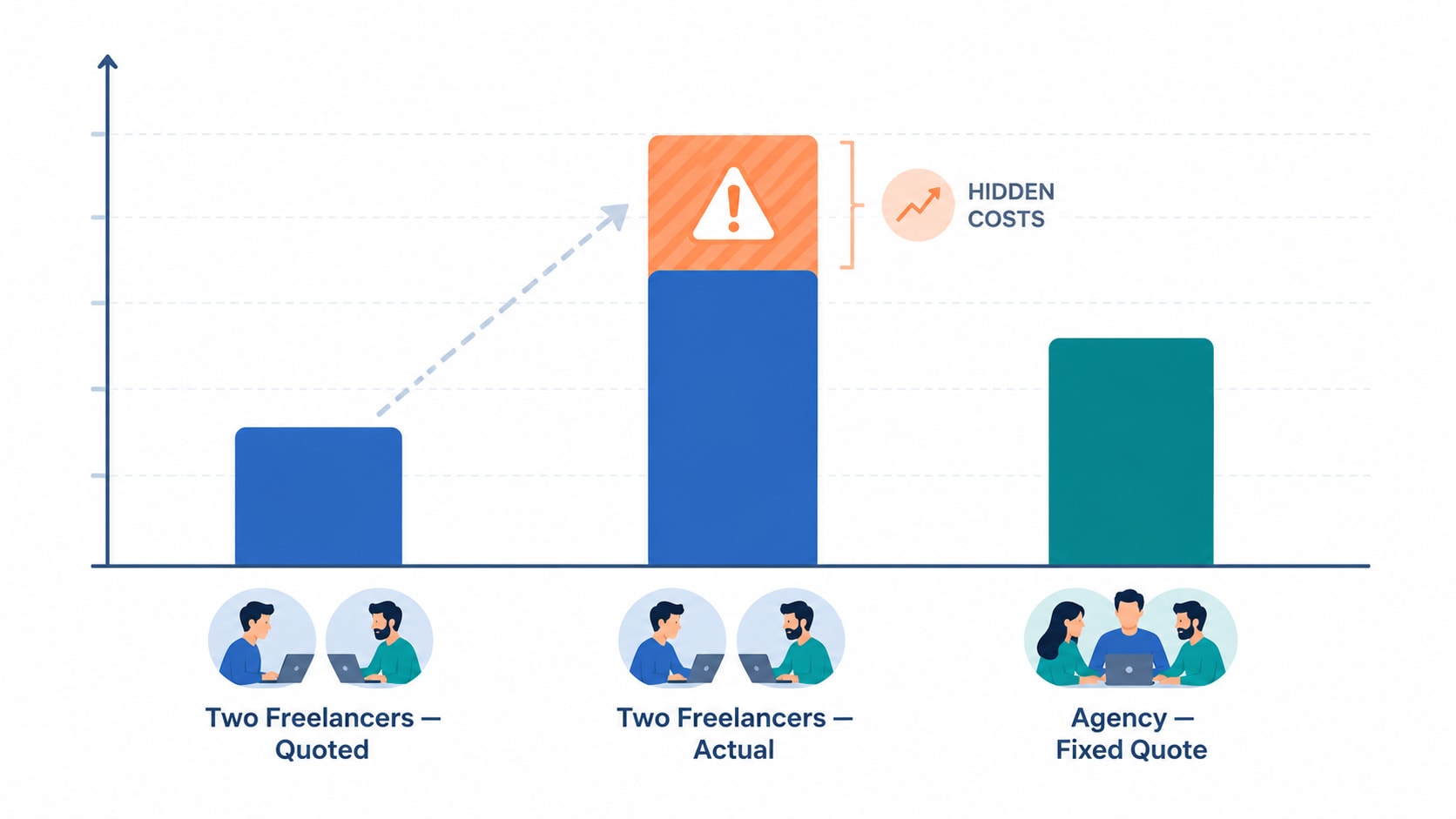
Side-by-Side: A Mid-Complexity App, Both Ways
Take a representative example: an app with accounts, user profiles, one payment integration, and a basic real-time feature — the kind of scope that describes most early-stage marketplace, service, or logistics apps.
- Two freelancers, quoted: ~₹8–11 lakh core development.
- Two freelancers, realistic total once design, QA, deployment, and coordination overhead are added back in: ~₹13–17 lakh, over a longer and less predictable timeline.
- Single lean agency, quoted and typically final: ~₹6–11 lakh, fully inclusive, with a defined delivery window and a post-launch warranty.
- In this scope, the freelancer route's real total often ends up higher than a fixed agency quote — the freelancer number just doesn't look that way until the coordination and rework costs show up.
When Freelancers Are Genuinely the Right Call
None of this makes freelancers a bad option in every case. They're the right call in specific, narrower situations:
- You already have an in-house technical lead or PM who can own integration and QA.
- You're adding one well-scoped feature to an app that already exists and works.
- You're validating a very narrow idea over a few weeks, not building a full product.
- You have the technical background to review code and catch integration issues yourself.
When an Agency Is the Better Bet
- You're building a full MVP from a rough idea and need discovery and scoping done properly, not skipped.
- You're a non-technical founder who can't personally review whether the mobile app and backend actually agree with each other.
- You have a real launch deadline and can't absorb the delays that come with coordinating two independent freelancers.
- You want a single accountable team and a warranty period after launch, not a project that's "done" the moment the last invoice clears.
How We Scope and Price Flutter Builds at Fall Rise
At Fall Rise, every build starts with a scoping call and a fixed, itemised quote before any code is written — no hourly guesswork, no surprise line items for deployment or QA later. Our Flutter, Node.js, and MongoDB stack is the same one behind Bhaada, our logistics platform, and it's the foundation for most of the products we've shipped for founders. Whether you're building a consumer app, a SaaS product, or need standalone backend and API work, mobile, backend, design, and QA sit under one roof and one contract — the coordination overhead this post has been describing, absorbed by us instead of billed back to you as rework.

The cheapest quote on paper isn't always the cheapest app you'll actually pay for. If you're comparing quotes and want an honest read on what a specific build should cost — freelancer route, agency route, or a mix — let's talk. We'll give you a real, itemised number, not a range designed to get you on a call.