SEO for Logistics Companies: How We Built SEO Into a Logistics Startup's Website
A pre-launch cargo delivery startup needed to win shippers and recruit drivers before its apps went live. Here's how we built local SEO into the Bhaada marketing site from day one.
Case Studylogistics-startuplocal-seomarketing-websitecase-studynextjs6 min read·· Updated
Short answer: SEO for a logistics company means being found by people searching for a service in a specific place — "tempo booking in Kanpur", "warehouse space near me", "same-day courier in Lucknow". That takes one page per city and service you actually offer, local business structured data, a Google Business Profile, fast mobile pages, and separate pages for each audience you serve. Below is how we did it for a real cargo startup, and how it applies to warehousing and delivery businesses. If you'd rather have it done for you, our SEO services start with a technical audit.
Most startups treat the marketing website as a brochure to finish before launch, and SEO as something to worry about later. For a logistics startup, that's backwards. Your first customers and your first drivers will search for you before they ever download an app.
Here's how we approached the Bhaada marketing website, and the playbook any logistics or delivery startup can reuse.
The challenge
Bhaada is an on-demand cargo delivery startup launching in Tier-2 cities in Uttar Pradesh: Kanpur, Lucknow, and Unnao. Before its apps went live, it had no digital presence at all, and it needed to do two very different jobs at once:
Win shippers: explain a multi-vehicle fleet to businesses used to booking trucks by phone.
Recruit drivers: convince vehicle owners that joining a new platform was worth it.
Compete locally against metro-focused competitors that already dominated search.
What we built (in 4 weeks)
1. City landing pages from day one
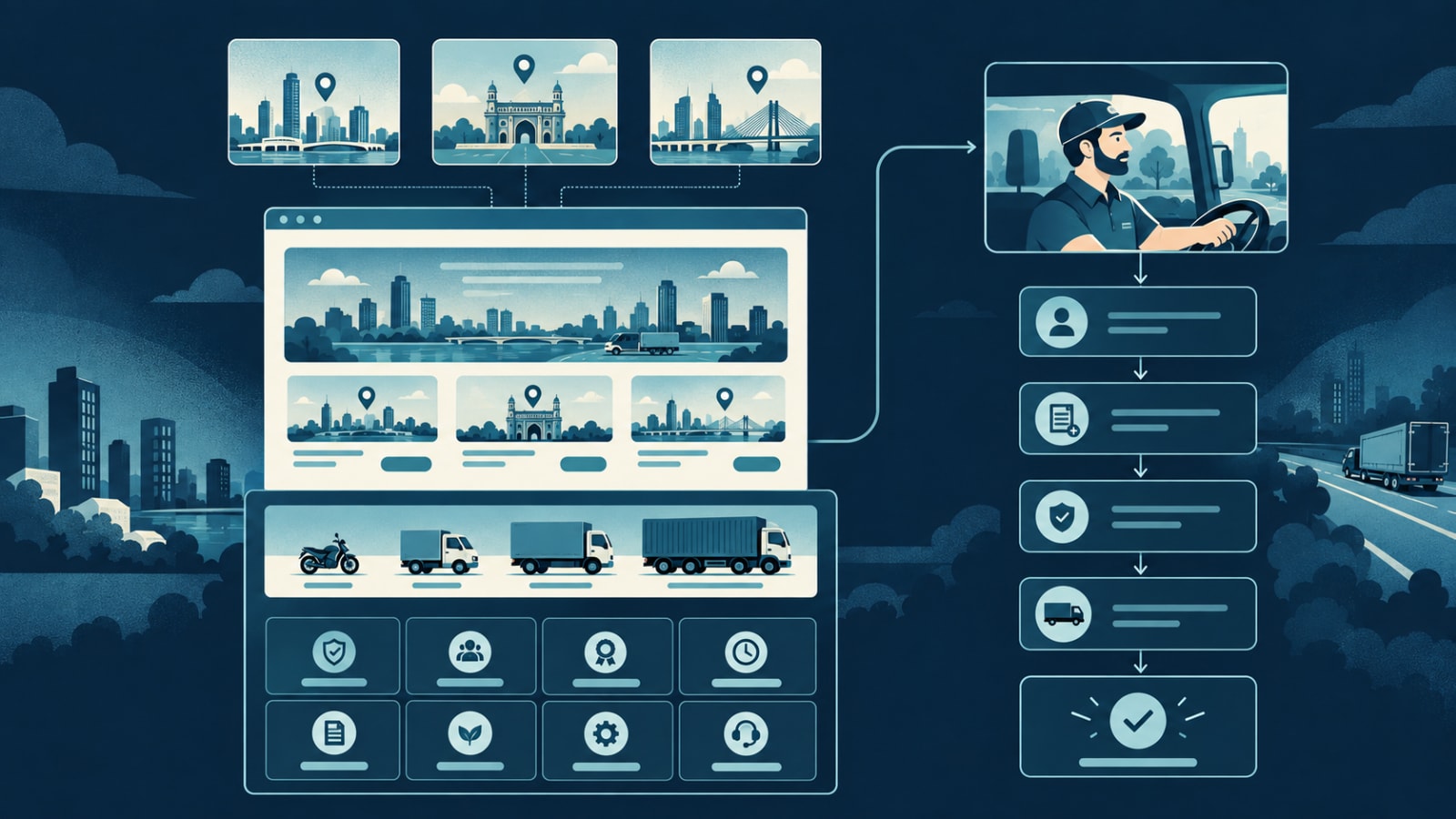
People search "tempo booking in Kanpur", not "logistics platform." City-specific pages targeted the markets Bhaada was launching in, positioning it as the hometown alternative to national players. A city coverage map made the launch areas clear at a glance.
2. Structured data for local search
JSON-LD structured data tells Google exactly what the business is, where it operates, and what it offers. It's a small technical step that helps search engines understand and display a local business correctly.
3. Fast pages on slow connections
Many target users browse on mobile data in smaller cities. The site was built with Next.js server-side rendering and images served through a CDN, so pages load quickly even on weaker connections. Page speed affects both rankings and whether a visitor waits around.
4. A fleet explorer that answers the real question
Shippers want to know one thing: which vehicle fits my load? An interactive fleet explorer shows seven vehicle types, from two-wheelers carrying about 30 kg to DCM trucks carrying 3,500 kg. It's useful content that also matches how people search.
5. Trust signals for a brand nobody knew yet
A new brand has no reviews, so the site leads with what reduces risk: instant booking, live tracking, OTP-secured delivery, GST invoicing, multi-stop routes, scheduled orders, coupons, and referrals.
6. A separate funnel for drivers
Driver-partners got their own earnings-focused messaging and direct registration calls to action, so two audiences never had to share one confusing page.
The logistics startup SEO playbook
Build one page per city or service area you actually operate in, with genuinely local content.
Create a page per vehicle type or service (mini-truck, two-wheeler, intercity) to match how people search.
Add structured data for your business, services, and locations.
Set up a Google Business Profile for each area you serve, and keep names and contact details consistent everywhere.
Optimise for mobile speed first; many logistics customers are on their phone.
Separate your audiences: customers, drivers, and business accounts need different pages.
Submit to Google Search Console and Bing on launch day, then keep going. Here's our post-launch SEO checklist.
SEO for Warehousing Companies
Warehouse buyers search by location and capability: "warehouse space in Bhiwandi", "cold storage near Surat", "3PL warehouse for e-commerce". The same playbook applies, with a few changes:
One page per warehouse location, with the address, area, dock count, and what the site handles (ambient, cold chain, bonded, hazardous).
Service pages for what buyers actually ask for — storage, pick-and-pack, e-commerce fulfilment, cross-docking — rather than one generic "services" page.
A Google Business Profile for each facility, with real photos and correct opening hours.
A simple enquiry form that asks for volume, product type, and dates, so sales gets qualified leads instead of "please call me".
SEO for Delivery Services and Courier Businesses
Delivery and courier searches are local and urgent — "same day delivery in Lucknow", "parcel pickup near me". Speed and clarity win:
City and area pages that show the pickup areas, delivery times, and how to book in the first screen.
A booking or quote form above the fold on mobile; most of these searches happen on phones.
Separate pages for business customers (bulk and recurring deliveries) and individuals.
Reviews on your Google Business Profile, which carry more weight than anything on your own site for "near me" searches.
Search rankings take months to build. A site that goes live weeks before the app gives Google time to discover and index it, so by launch day it's already appearing for local searches. The site itself was built by one engineer in four weeks, on Next.js and Vercel, which kept costs lean for an early-stage startup.
The marketing site was step one. The platform behind it (booking, dispatch, and live tracking) is a bigger build, which we break down in cargo booking platform development.
FAQ
How do logistics companies get more leads from Google?
Create a page for each city and service you offer, add local business structured data, keep a Google Business Profile for every location, make pages fast on mobile, and put a booking or quote form where people can see it straight away. Then track which searches bring enquiries in Google Search Console and build on them.
How long does SEO take for a logistics business?
Expect a few weeks for Google to index a new site, and several months before local pages rank consistently. Starting before launch, as Bhaada did, means some of that waiting happens while the product is still being built.
Do I need separate pages for each city?
Yes, for cities you actually serve — with real local details like areas covered, vehicles available, and delivery times. Thin copies of the same page with only the city name changed don't rank well and can hurt the whole site.
What does an SEO service for a logistics company include?
Usually a technical audit (speed, indexing, structured data), page structure for cities and services, Google Business Profile setup, content for the questions customers ask, and monthly reporting from Search Console. Our SEO services include the code fixes as well as the plan.