
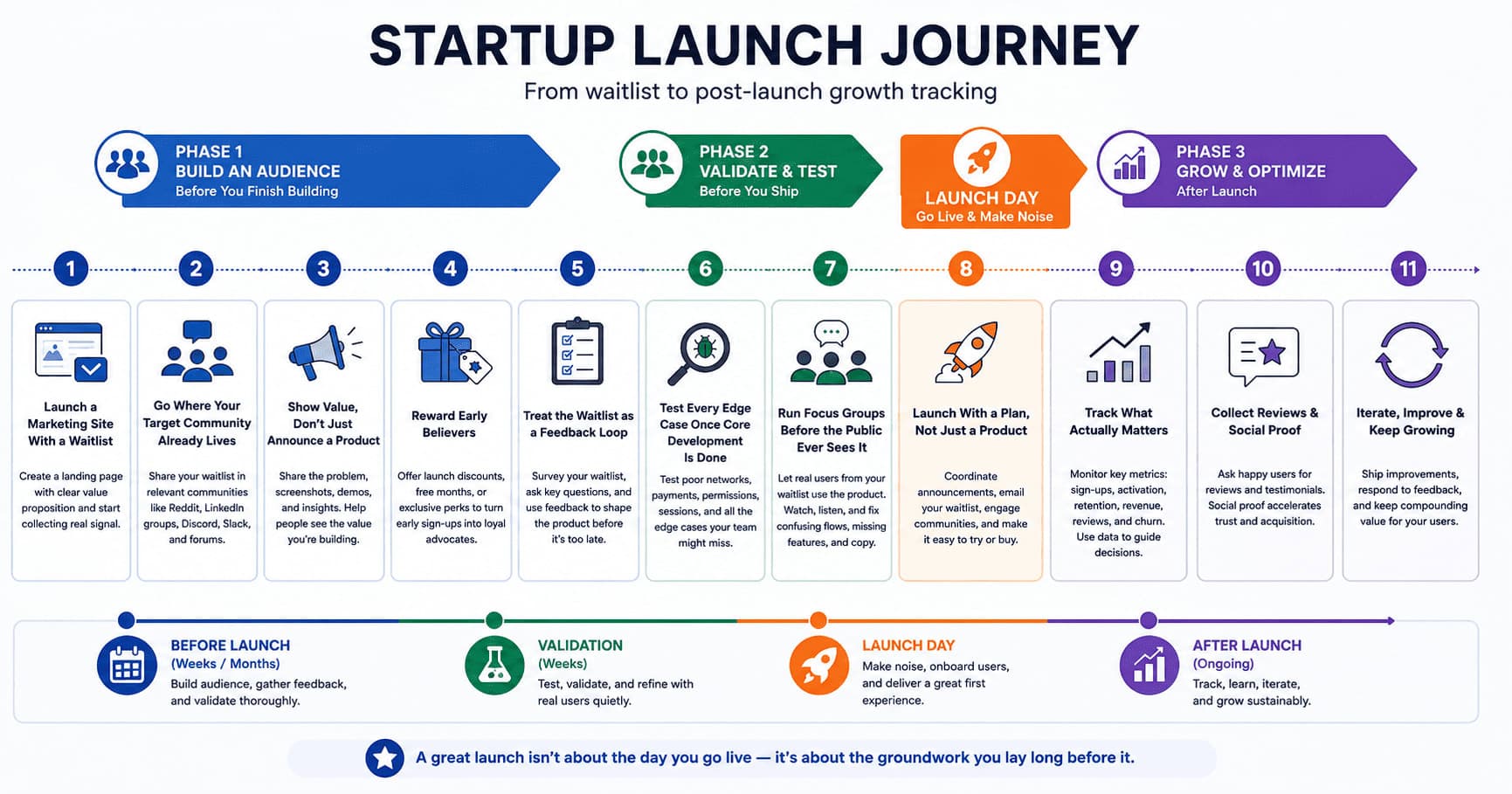
Most founders think of "launch" as the day their app appears in the App Store. In practice, launch day is the least important part of a successful launch — it's just the visible moment at the end of months of quieter work. The startups that get real traction on day one are almost always the ones that built an audience, tested with real people, and had a distribution plan long before they shipped. Here's the sequence we walk clients through, and why the order matters as much as the steps themselves.
Phase 1: Build an Audience Before You Finish Building the Product
The biggest mistake early founders make is treating marketing as something that starts after development ends. By then it's too late to learn anything — you're marketing to silence. The goal in this phase is to have real people paying attention to your product before it's finished, so their feedback can still shape it.
1. Launch a Marketing Site With a Waitlist
A simple landing page with a clear value proposition and a "join the waitlist" form is the fastest way to start collecting real signal — sign-up numbers, where traffic comes from, and which messaging actually converts. This site doesn't need your final branding or a working product behind it; it needs to explain the problem you're solving clearly enough that a stranger signs up to hear more.
2. Go Where Your Target Community Already Lives
A waitlist site with no traffic tells you nothing. Once it's live, put it in front of the specific communities your target users already spend time in — relevant subreddits, LinkedIn groups, niche Discord or Slack communities, and industry forums. This matters more than broad social posting, because a hundred sign-ups from your exact target audience are worth more than ten thousand impressions from people who will never use the product.
3. Show Value, Don't Just Announce a Product
"We're building something" doesn't convert. Share the actual problem you're solving, early screenshots, short demo clips, or the reasoning behind a design decision. People join waitlists and stay engaged when they can see a product taking shape and understand exactly what's in it for them — not when they're asked to trust a vague promise.
4. Reward Early Believers
Give pre-registered users a reason to have joined early — a launch discount, extended free trial, or founding-member perks. This does double duty: it improves your waitlist conversion rate, and it turns your earliest users into people who feel invested in your success, which matters enormously for the reviews and word-of-mouth that follow launch.
5. Treat the Waitlist as a Feedback Loop, Not Just a List
Survey your waitlist. Ask what they expect, what would make them stop using a product like this, and what they'd pay for it. Feed that directly into your development priorities while there's still time to act on it. A waitlist that only receives one launch-day email was a missed opportunity — the real value is in the conversation you have with it while building.
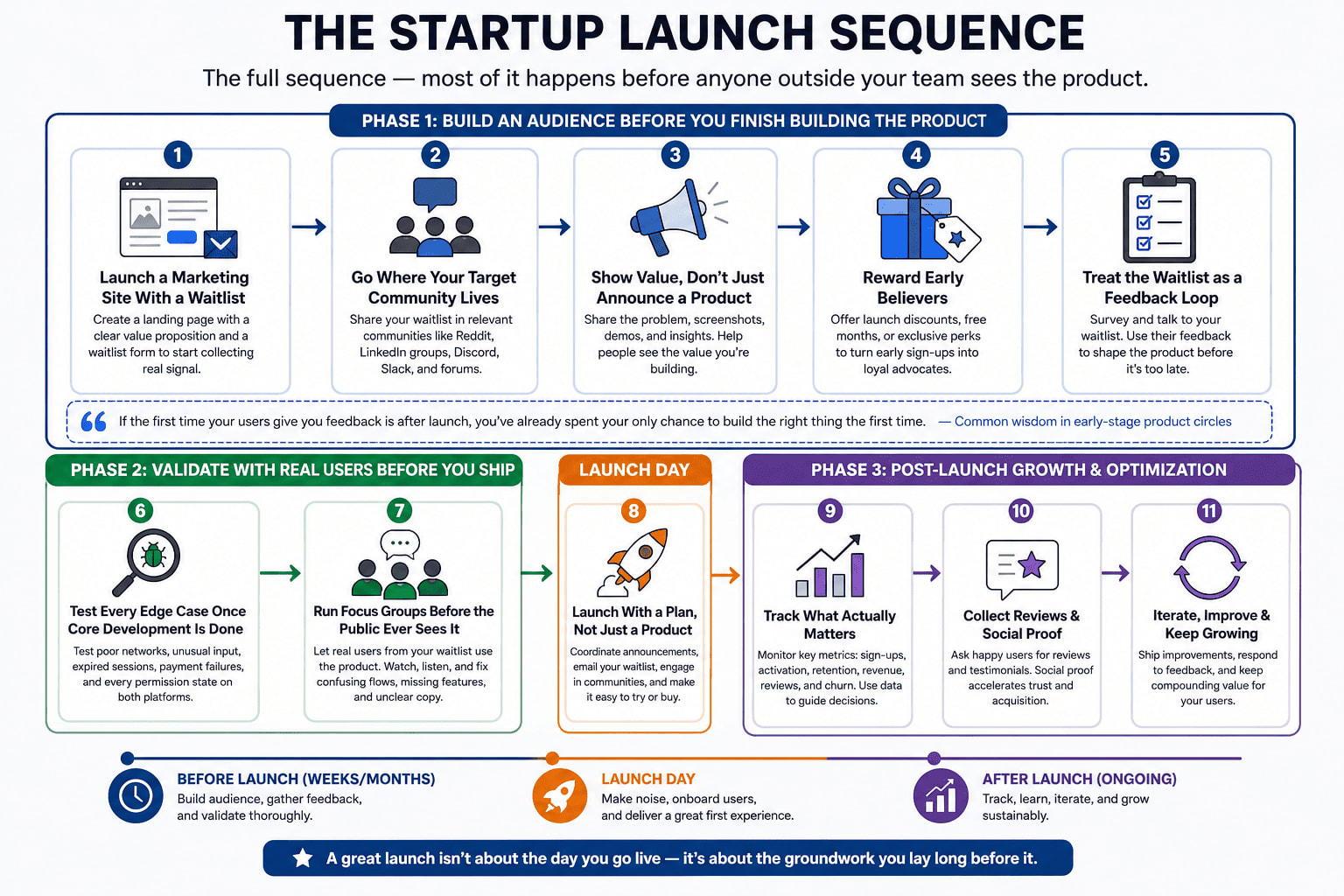
If the first time your users give you feedback is after launch, you've already spent your only chance to build the right thing the first time.
Common wisdom in early-stage product circles
Phase 2: Validate With Real Users Before You Ship
6. Test Every Edge Case Once Core Development Is Done
Before anyone outside your team touches the product, run it through the scenarios your own team is most likely to overlook — poor network conditions, unusual input, interrupted payments, expired sessions, and every permission-denied state on both platforms. Edge cases feel like low priority right up until one of them causes a one-star review in week one.
7. Run Focus Groups Before the Public Ever Sees It
Give a small group of real target users — ideally pulled from your waitlist — access before launch, and watch how they actually use the product rather than how you assumed they would. This surfaces confusing flows, missing features, and unclear copy while there's still time to fix them quietly, instead of discovering them in public reviews after launch.
Phase 3: Get Launch-Ready
- Lock a launch date and get store-approved builds ready — submit early enough to absorb app store review time and rejection cycles without it eating into your launch window.
- Register on launch platforms in advance — Product Hunt and similar communities reward preparation; have your listing, assets, and outreach to supporters ready well before the day you actually go live.
- Notify your pre-registered users directly — a personal, well-timed email or in-app message to everyone who signed up on your waitlist, giving them first access and their promised early-bird offer.
Phase 4: Launch Day
By the time launch day arrives, most of the hard work should already be done — this is execution, not discovery. Push your marketing plan across every channel where you built an audience in Phase 1, publish the update on your website, and go live on your chosen launch platforms at the time that gets you the most attention from your specific community, not just the most generic traffic.
Phase 5: What Happens After Launch Matters More Than Launch Day
Keep the Feedback Channel Open
Give users an easy, visible way to report bugs and request features — through the website, in-app, or both — and make sure it's actually monitored. The founders who keep listening past launch day are the ones who catch problems before they become churn.
Ship and Communicate Regular Updates
Monthly or quarterly updates, communicated clearly to your users, signal that the product is alive and actively improving. This is also where the feature requests and feedback you collected get turned into visible progress — closing the loop with the people who took the time to tell you what they needed.
Track Acquisition, Engagement, and Retention From Day One
Know where your users are coming from, how often they come back, and where they drop off. These three numbers, tracked consistently, tell you far more about whether your launch actually worked than download counts or a single good week ever will.
How We Approach This at Fall Rise
We build this launch sequence directly into the timeline for the products we ship, not as an afterthought once development wraps. Take a look at some of the apps we've built and launched to see how waitlist-driven validation and post-launch iteration play out in practice — the pattern holds whether it's a consumer app or a marketplace platform.
A good launch isn't a single day — it's a sequence that starts with a waitlist and ends with a habit of shipping and listening. Get the order right and launch day becomes a formality; get it wrong and no amount of marketing spend on the day itself will fix a product nobody validated first. If you're planning a launch and want help getting the sequence right, let's talk.