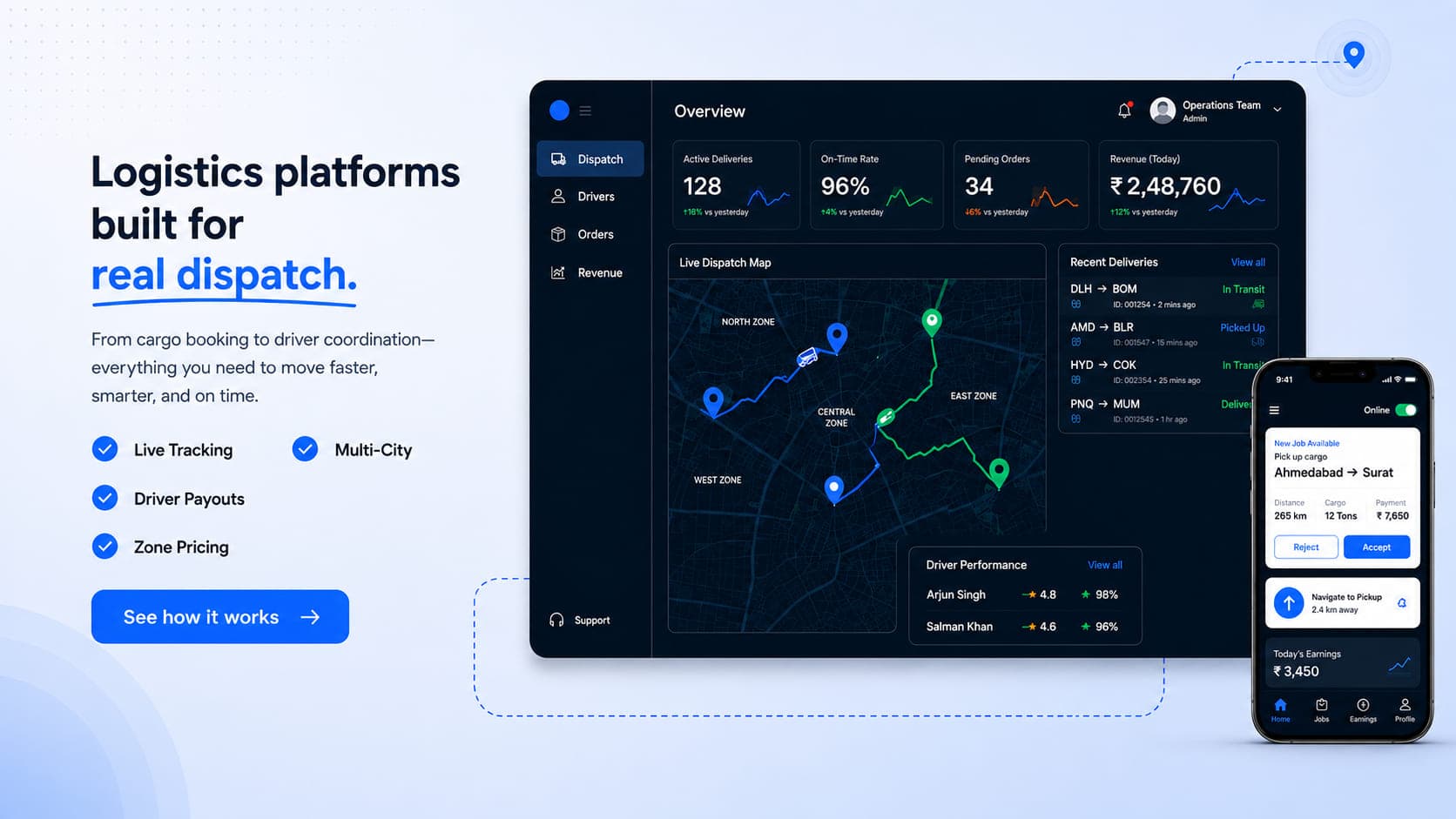
Logistics platform development means building for coordination — a booking on one side, a driver on the other, and dispatch logic that has to hold up under real-world traffic, not a demo. We've built the full stack for this: customer-facing booking apps, driver-partner apps, and the admin platforms that tie dispatch, pricing, and payouts together.
Where we've worked in this space:
- Multi-stop cargo booking with live tracking and location-aware driver matching
- Driver-partner apps — real-time job alerts, navigation, and wallet payouts
- Admin platforms for pricing zones, driver onboarding, and revenue tracking
- Bilingual marketing sites built to grow both sides of a two-sided marketplace
The problems a logistics platform has to solve
Most small and mid-size transport operators still take bookings by phone and coordinate drivers over WhatsApp. That works until volume grows — then bookings get missed, customers can't see where their cargo is, drivers sit idle between jobs, and payouts turn into a weekly reconciliation exercise. A logistics platform replaces those manual hand-offs with one shared system that the customer, the driver, and the operations team all see in real time.
What we build
| Component | What it does |
|---|---|
| Customer booking app | Multi-stop bookings, scheduled orders, coupons, and live order tracking |
| Driver-partner app | Online/offline availability, job alerts, turn-by-turn navigation, OTP-verified pickup and drop, wallet payouts |
| Dispatch and matching | Location-aware driver assignment (for Bhaada, an Uber H3 grid) so the nearest available driver gets the job |
| Operations portal | Pricing zones, driver onboarding, order oversight, and revenue tracking |
| Marketing site | City landing pages and driver sign-up, bilingual where the market needs it |
Case study: Bhaada
For Bhaada, an on-demand cargo delivery startup in Uttar Pradesh, we built the whole platform: a customer app, the Bhaada Buddy driver-partner app, an operations portal, and a bilingual Hindi and English marketing site with city pages for Kanpur, Lucknow, and Unnao — all backed by one real-time system.
Timeline
A focused MVP — one customer app, one driver app, and a basic admin panel — typically takes 6–12 weeks, depending on how complex dispatch, pricing, and payouts are. We confirm the timeline after scoping your v1.