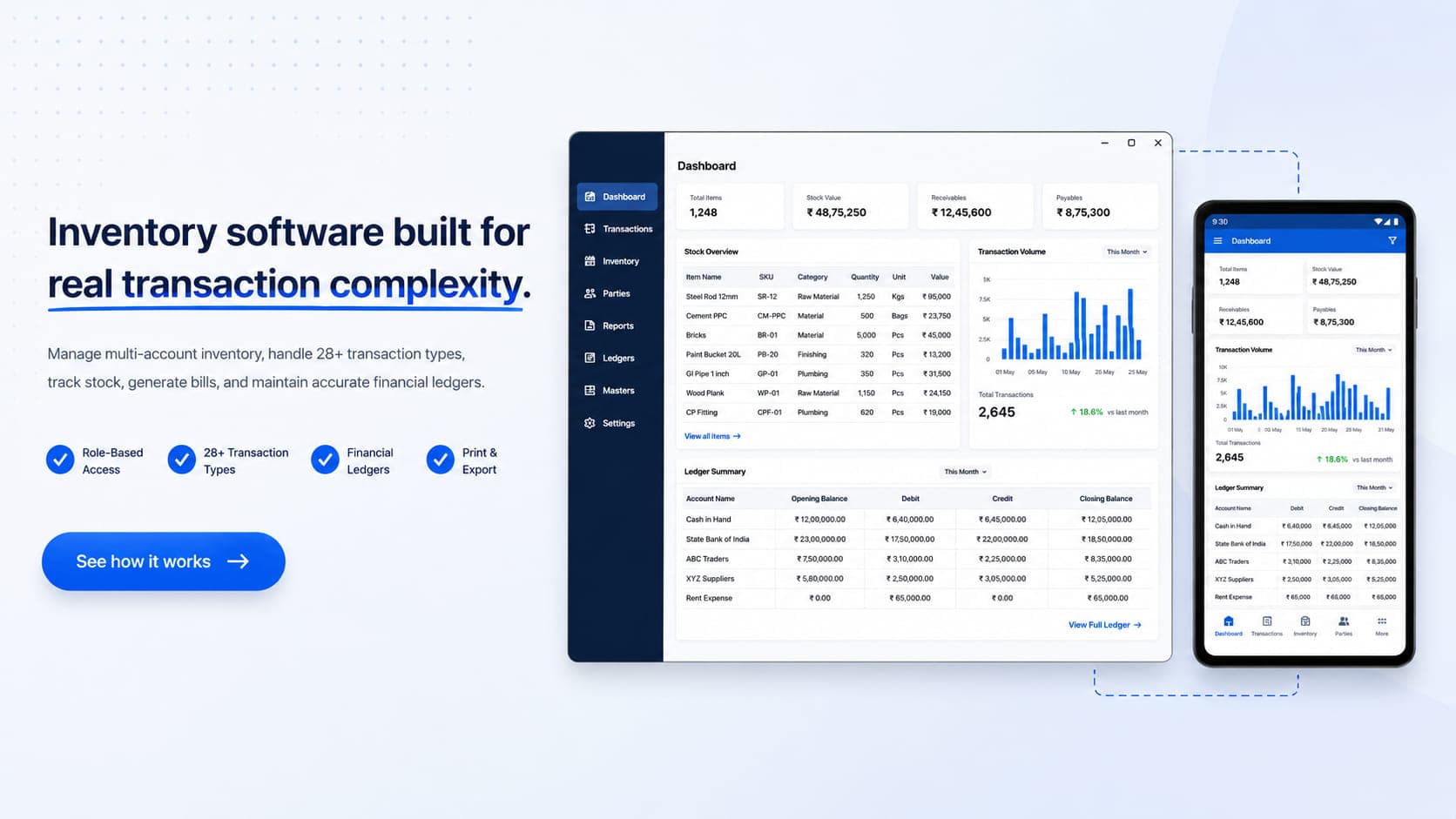
Manufacturing and industrial operations often run on transaction types and reporting needs that generic inventory software doesn't cover — multiple account types, dozens of process variations, and financial ledgers that have to be exactly right. We build for that complexity instead of forcing it into a generic template.
Where we've worked in this space:
- Multi-account inventory and billing systems with role-based access
- ACID-compliant transaction engines covering dozens of process types
- Financial ledgers, reporting, and print/export built for real accounting needs
- Cross-platform delivery — Android and Windows from one codebase
Why generic inventory software falls short
Off-the-shelf inventory tools assume a simple buy-stock-sell flow. Real manufacturing and trading businesses have job work, returns, material issued to karigars or vendors, partial deliveries, and several accounts per party — and every one of those has to move stock and money correctly at the same time. When the tool cannot model a transaction, it ends up in a side spreadsheet, and the stock and ledger numbers drift apart.
What we build
| Component | What it does |
|---|---|
| Transaction engine | Every process type as its own transaction, with stock and ledger updated together or not at all (ACID) |
| Inventory and billing | Multi-account stock, bills, and returns that match how the business actually trades |
| Ledgers and reports | Party ledgers, financial reports, and print and export for accounting |
| Access control | Role-based access so staff see and change only what their role allows |
| Platforms | Android and desktop (Windows, macOS) from one codebase |
Case study: Umiya Jari inventory system
For the jari textile business behind Umiya Jari, we built cloud-based inventory and billing software with multi-account support, 28 transaction types, financial ledgers, print and export, and role-based access, running on Android and Windows.
Timeline
A focused MVP typically takes 6–12 weeks. The main driver is how many transaction types you run and how they affect stock and accounts, so we map those first during scoping.