

Ask ten founders what to build first and nine will say the same word: MVP. Ship something small, ship it fast, learn from real users. It's good advice — until it hardens into a reflex. Somewhere along the way, "build an MVP" stopped being a deliberate choice and became a race: a pressure to get anything live as quickly as possible, regardless of whether speed was actually the constraint that mattered. That race is worth resisting. The real question was never "MVP or full product" — it's what you're actually trying to learn, and how much you already know.
The MVP Race Nobody Should Actually Be Running
The Lean Startup popularised the MVP for a good reason: most early-stage ideas are wrong in some way, and the cheapest way to find out is to build the smallest thing that tests the riskiest assumption. But "smallest and fastest" quietly turned into "rushed," and rushed is not the same thing as lean. A founder who already has funding, a validated pain point from years in the industry, and paying customers waiting on day one doesn't need to relearn what they already know — they need to build the thing well. Racing to market when there's no real market-timing pressure just means shipping something thin, watching it fail to convert, and blaming the strategy instead of the execution.
What an MVP Is Actually For
An MVP earns its place when the biggest risk in your business is uncertainty about demand or behaviour — not uncertainty about execution. It exists to answer questions cheaply before you commit real engineering budget to answering them expensively. That's the whole job.
- You don't know if anyone wants this — the core value proposition is a hypothesis, not a proven need.
- You're choosing between several possible directions — and building all of them fully would burn your entire runway before you learn which one works.
- Your audience will forgive rough edges — early adopters in a new category tolerate friction in exchange for solving a real problem first.
- You need real usage data, not opinions — internal debate about what users want has stalled, and only shipping something will settle it.
When "Minimum" Becomes a Liability
The MVP model assumes your users are forgiving and your market is unclaimed. Neither is always true. There are specific, recognisable situations where shipping thin is the more expensive mistake — not the safer one.
- You're entering a market with an established incumbent. If users already have a competent alternative, a bare-bones version doesn't feel like an early product — it feels like a worse product. You need enough completeness to win a direct comparison, not just a first impression.
- The domain is regulated or high-trust. Healthcare, fintech, and anything handling sensitive personal data can't defer compliance, security, or data-handling maturity to "version two." An MVP that skips these isn't lean, it's a liability waiting to surface.
- You already have deep validation. If you've spent years inside the problem — as a domain expert, or from a previous company that hit the exact same wall — you're not testing whether the need exists. You're already past that question, and building thin just delays the product you already know you need to build.
- Brand and first impression carry disproportionate weight. Premium, consumer-facing products where quality signals trust (financial tools, health products, anything people pay a subscription for) lose credibility fast if the first release feels unfinished.
- You have funding and a real runway. Racing to a bare MVP mostly protects against burning cash before learning something important. If that specific risk isn't present, the justification for rushing weakens considerably.
An MVP is a tool for reducing a specific risk. If that risk isn't the one you're actually carrying, building an MVP just delays the product you already know you need to build.
Working principle we use when scoping new client projects at Fall Rise
The Real Question Isn't MVP vs Full Product
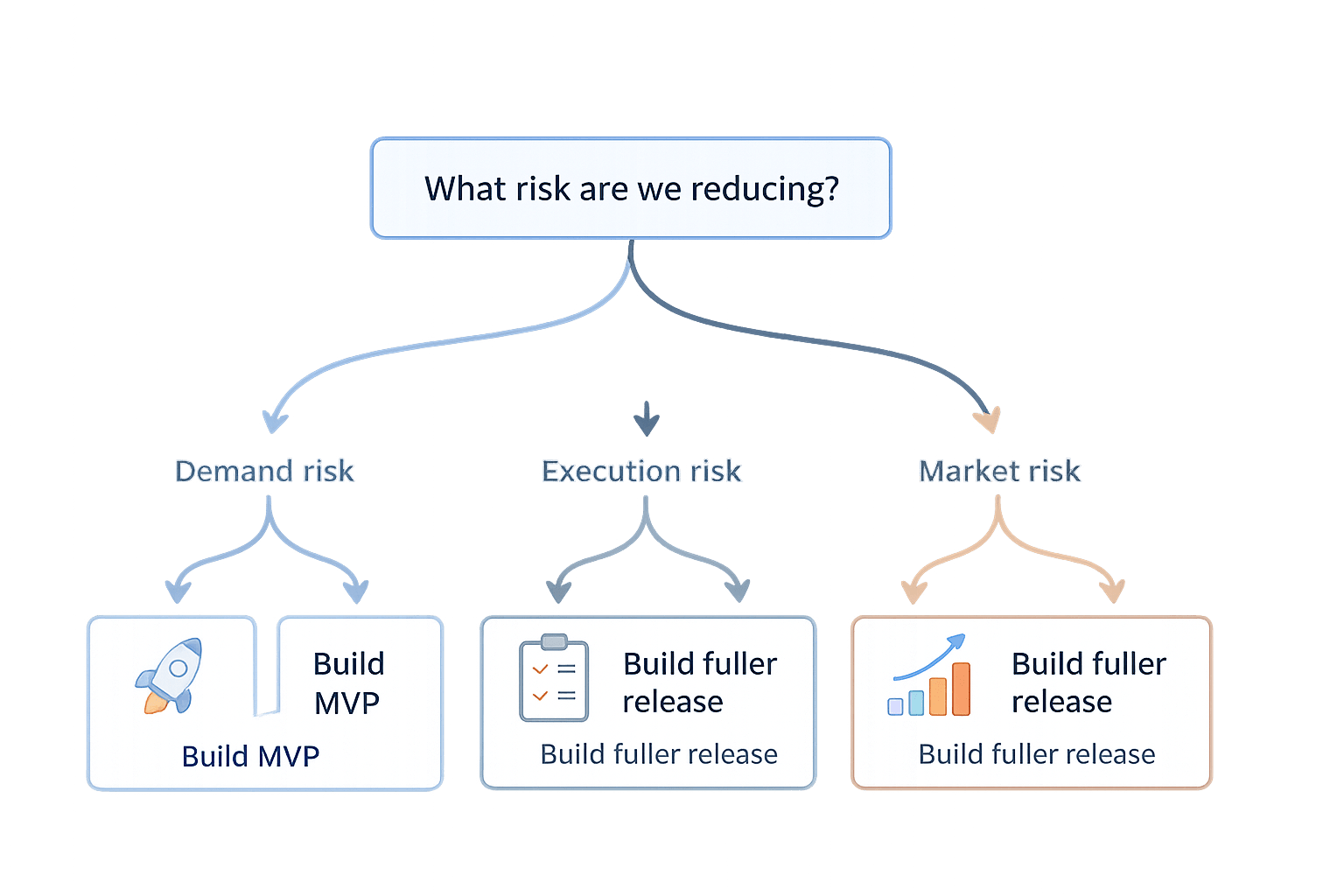
Framing the decision as a binary — minimal now, complete later — hides the actual variable that matters: what do you not yet know, and what does it cost to find out? Every startup carries some mix of demand risk (will anyone use this), execution risk (can we build it well enough), and market risk (will this still matter by the time we ship). An MVP is a good answer to demand risk. It's a poor answer to the other two. Naming which risk you're actually carrying, before writing a single feature list, changes the entire scoping conversation.
A Simple Framework for Deciding
1. Name the risk you're actually reducing
Write down, in one sentence, the single biggest unknown standing between you and a sustainable business. If it's "we don't know if people will pay for this," an MVP makes sense. If it's "we know they'll pay, we just need to build it properly," a leaner-but-complete first release is the better allocation of budget.
2. Separate scope from quality
"Minimum" should describe the number of features, not how well the features you do include actually work. A three-feature product with a broken onboarding flow and slow load times teaches you nothing useful — users will blame the execution, and you'll misread that as a signal about the idea. Cut scope aggressively. Never cut polish on the scope you keep.
3. Decide what "later" actually means
Every deferred feature needs an honest answer to "what happens if we never build this?" If the answer is "nothing, we'll add it if usage justifies it," defer it with confidence. If the answer is "we lose credibility with the exact segment we're targeting," it isn't actually optional — it belongs in the first release, MVP label or not.
How We Approach This at Fall Rise
Every client engagement starts with this same conversation before any wireframe gets drawn: what risk are we actually reducing by scoping it this way? For some founders, that's meant a genuinely minimal first release, tested with a small user group before a single rupee goes into scaling infrastructure. For others — particularly logistics and marketplace products where trust and reliability are the product — it's meant pushing for a more complete first version because a thin launch would have undermined the exact confidence the product depends on. Bhaada, our parcel and logistics platform, is a case in point: drivers and shippers needed to trust the platform from day one, so "minimum" there meant a lean feature set built to a genuinely reliable standard, not a rough first draft. You can see how that scoping plays out across different products in our project portfolio.
"Build an MVP" is good advice applied badly more often than it's bad advice. The goal was never speed for its own sake — it was spending the least money necessary to learn the thing you don't yet know. Sometimes that means shipping in six weeks. Sometimes it means taking three extra months to get the first version right, because the risk you're actually carrying has nothing to do with whether people want the product. If you're trying to figure out which one applies to you, we've had this exact conversation with dozens of founders — let's talk about what your first release should actually include.